
FFFA 2026 Film Review - Onibaba
Images courtesy of Fantastic Film Festival Australia.
Kaneto Shindo’s 1964 period horror Onibaba is a tactile assault on the senses, a sweat-soaked fever dream that conjures up primal feelings of dread, horror and lust. Set during the chaotic Sengoku civil wars, the film follows a mother and her daughter-in-law as they scrape out a brutal existence in a vast field of towering reeds somewhere outside Kyoto. Waiting for their husband and son to return from war, the women survive by killing lost soldiers and selling their weapons and armour for millet. When their neighbour returns from war, the younger woman begins an affair with him which sets in motion a spiral of rage, jealousy, and demonic violence.
Captured in crisp black and white, Onibaba manages to fill its runtime with breathtaking imagery despite its simple setting. The film contains minimal dialogue, relying on theatrical physical performances and stunning compositions to tell its story visually. Every claustrophobic frame is packed with palpable tension that one can almost feel—the characters spend their days and nights covered in sweat, writhing on their straw beds, unable to sleep from the overwhelming heat of jealousy and unrest. The reeds surrounding their hut stretch high into the sky, closing in on them, constantly swaying in the wind, revealing and obscuring in equal measure.
The film opens on a hole in the ground, a titlecard telling us: “THE HOLE. DEEP AND DARK. ITS DARKNESS HAS LASTED SINCE ANCIENT TIMES.” Lingering, quiet shots of the hole and surrounding reeds are interrupted by a crash of sound: a chaotic, abrasive opening song gives way to the sharp clatter of horse hoofs, armour, and weapons, as soldiers are cornered and killed among the labyrinth of reeds. This sequence of quiet, primordially evil images of the hole and landscapes being interrupted by sudden, messy violence repeats throughout the film with a dizzying sense of inevitability. The soldier’s stripped corpses are flung into the hole to be forgotten about—raising a crude metaphor for humanity’s endless capacity to fall into darkness at the first signs of societal crumble from the very first scene.
Through his morally grey main characters, Shindo offers a feminist-adjacent critique of patriarchal structures like war and feudalism. His frequent collaborator Nobuko Otowa plays the older of the two women, who feels as if she has to compete with her daughter-in-law and be seen as an object of sexual desire if she wants to survive. For its time, the film feels particularly transgressive in its approach to sexuality and violence. Its suffocating and hypnotic rhythm, and stark, documentary-style visuals give a dangerous intimacy to moments of pained eroticism that would have never made it into the films of contemporary Hollywood.
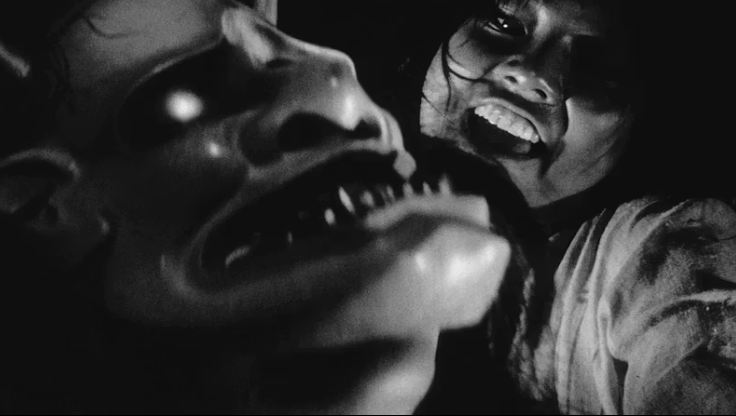
These darkly modern sensibilities constantly brush up against ancient symbols like the endless landscape, the dark hole, elements of Japanese folklore and karmic concepts from Buddhism. This ever-present motif is cemented with the film’s most iconic image: a wooden kabuki mask, the face of a demon twisted into an uncanny, terrified, unmoving smile. While not an out-and-out horror movie, the mounting tension up until the mask’s arrival gives way to a deep, choking dread that fills every moment it is on screen. Murmurs of mysticism, dark enchantments—perhaps a curse—shroud the mask in ancient and awesome power. Not a power to be trifled with. But, as humans do, Otawa’s character cannot help but utilise the mask for her own benefit, perverting this object of mysterious, primal origin, and hurtling the film towards a dread-soaked climax that feels cosmically inevitable.
Onibaba is not a typical horror film—it is slow, subdued, almost repetitive, but its incredible, stark visuals will stick with viewers, especially the particularly spine-chilling image of the demon mask, peeking its way through the reeds, at once horrifying and painfully horrified.
Follow Harvey on Letterboxd and Instagram.
Onibaba screened as part of the 2026 Fantastic Film Festival, whichran from the 23rd of April to the 15th of May. Check out the festival website for more info here.