
Japanese Film Fest 2025 Review - Serpent’s Path
Images courtesy of Original Spin.
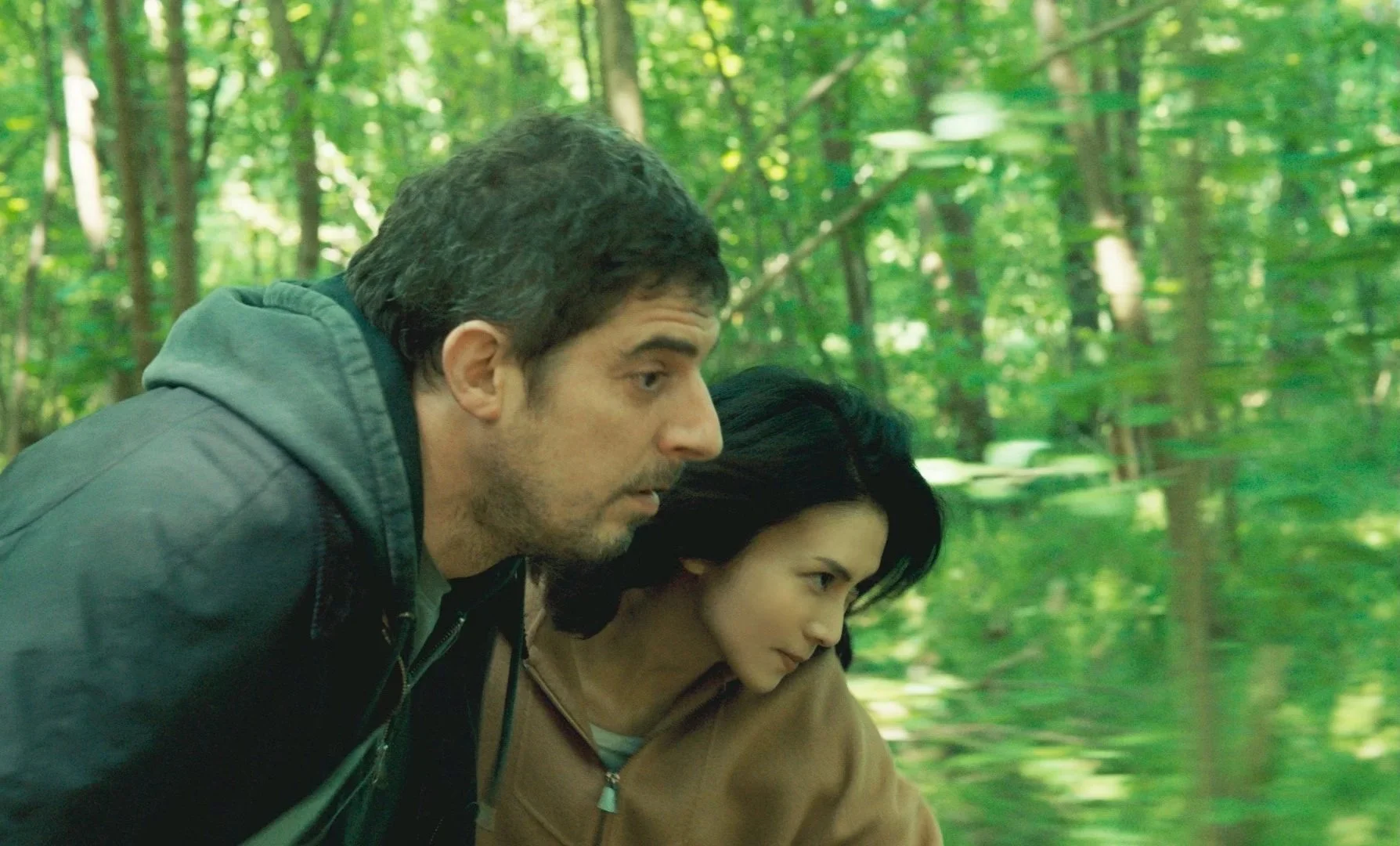
Serpent's Path tells the story of Sayako (Ko Shibasaki), a doctor who assists a patient, Albert (Damien Bonnard), in tracking down and getting revenge on a ring of child sex and organ traffickers responsible for the gruesome death of his daughter. Sayako and Albert initially kidnap and chain up a former accountant for the “Foundation”, Laval (Mathieu Amalric, who bears a striking resemblance to David Mitchell), and show him home video footage of Albert's daughter whilst reciting a disturbing monologue of the autopsy findings from her death. From here, the pair interrogate and delve deeper and deeper into a criminal conspiracy that, like Kiyoshi Kurosawa’s other films, is far more about the inner turmoil and single-mindedness of its lead characters in a hostile, industrial world than it is about the conspiracy itself, which seemingly winds up being ever more circular in nature as the film progresses.
The film is one of three new feature films premiered in 2024 by Kurosawa, along with the also-impressive Cloud, and Chime (which I haven't seen yet as of writing this). It speaks to his ever-enduring prowess that all three are so drastically more competent on a directorial level than most modern genre output of this calibre, while still effectively functioning perfectly as regular thriller genre films. Serpent’s Path is a French remake of Kurosawa's own 1998 film of the same name, one of five feature films directed by Kurosawa between his two most famous films: Cure (1997) and Pulse (2001). Most of the characters are now French, with only a handful, including Sayako, being played by Japanese actors (more on that later). Cinefrance Studios offered Kurosawa the chance to remake one of his own films in France, and Serpent’s Path was his choice. Sensible is perhaps an apt word for Kurosawa’s approach to the remake, which is suitably mostly a run-through with some structural and cultural changes, many of its striking dialogue exchanges and images being lifted straight from the original. Kurosawa claims to have only revisited the script whilst preparing for the remake, without rewatching the film, so with the high amount of visual parallels between the two, it is a testament either to an apparent photographic memory of his or an ability to independently conjure identical images from the same script - both are equally impressive to me!
Like all of Kurosawa’s films, Serpent’s Path is filled to the brim with such evocative images of mundane criminality and the bleak and brooding horror of industrial spaces, seen so often in crime films but rarely shot as atmospherically as with Kurosawa’s hand. One of note is an exceptionally well-composed moment of controlled chaos where Sayako, in the centre of the frame, welds new chains into place beside a terrified Laval, who is eating food off the floor, whilst Albert loudly practices firing a gun–all three are in the same frame at once, and it feels a bit more sensibly composed than the original’s example, which features an identical scene. The sheer might of the industrial environments that dominate the landscape settings of both films are both toxic to and enabling of their pursuits, and at all times Kurosawa knows how to capture this feeling of endless cyclical entrapment. The remake’s change of setting whilst maintaining the Japanese connection is immensely inspired. I particularly enjoyed Sayako’s subplots in which she speaks with a Japanese patient who feels immensely disenfranchised and depressed throughout his stay in Paris for work, as well as her interactions with an ex-boyfriend of some description from Japan via video call–these scenes are notably also composed in a very terrifying manner that befit the sense of disconnect felt by Sayako and her Japanese colleagues to her environment.
The uncanny direct bluntness of the original film’s persistent Lost Decade commentary, equally effective in that film, is all over replaced with a modern disturbia, something Kurosawa is exceptionally good at adapting to, as seen in Cloud which is in eerily enthusiastic conversation with Serpent’s Path at all times. Both films are about uniquely modern criminal conspiracies that unveil the mundane desperation of the lead and their co-conspirators, especially in how much their respective pursuits–revenge in Serpent’s Path and scalping in Cloud–have already consumed them by the start of the film. By the time we as an audience are introduced to them, these characters are merely going through the disturbing motions of mundane criminality, and aren’t always particularly good at it either, frequently bumbling through situations in a darkly hilarious fashion. This is evident in a scene in which Sayako and Albert outrun someone shooting at them with a shotgun while dragging along a captive Guérin (Grégoire Colin) in a sleeping bag–similarly a moment lifted from the original with some changes.
I cannot recommend seeing all three of Kurosawa’s latest features at the 2025 Japanese Film Festival enough. I have spent much of this review talking about Serpent’s Path in the context of its remake status due to its high similarity, admitted by Kurosawa himself, but this is in no way meant to overshadow the fact that Kurosawa is still working on a remarkably high level of originality in this and his other current films. The man has a laundry list of films to explore from the past four decades, and I feel as though I’ve only scratched the surface!
Follow Malachy on Letterboxd and Instagram.
Serpent’s Path is screening as part of the 2025 Japanese Film Festival, running in Melbourne from the 6th of November to the 4th of December. For tickets and more info, click here.