
MIFF 2026 - Nadja Review: A Stunning 90s Vampire Cult Classic Finally Awakens From Its Crypt To Sink Its Teeth Into Audiences
Images courtesy of Arbelos Films.
The vampire film has long been a profoundly expressive, free-flowing canvas of cinematic decadence, and Nadja glides like an echo through a shroud of distinctly 90s sensibilities.
Written and directed by Michael Almereyda and executive produced by David Lynch (who also features in a short but memorable cameo), Nadja follows the titular daughter of Count Dracula, who has to come to terms with her father’s death at the hands of an aging Van Helsing, hoping to find a release from the existential ennui of immortality and attempt to find freedom from her family curse. Her exhausting loneliness and desperate craving for connection lead her to give in to her predatory nature and ensnare a woman named Lucy, who just so happens to be the wife of Van Helsing’s nephew, in her seductive web.
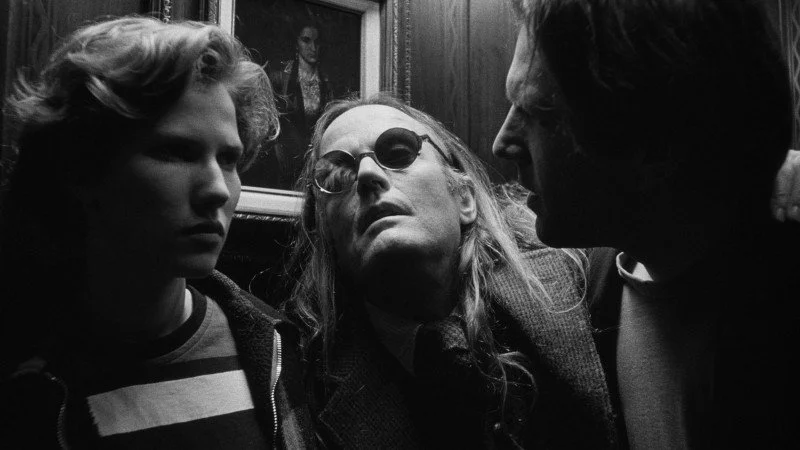
Like other films in its bloodsucking canon, namely the works from Jean Rollin and particularly Abel Ferrara’s The Addiction, Nadja is primarily a mood piece that sidelines a tightly composed plot with a conventional forward momentum, for a lush, poetic melancholy that bleeds from each frame. Luckily enough, director Michael Almereyda sweeps viewers up in a symphony of visual lust, precisely composing each frame with a great sense of space and depth to slowly draw you in. Primarily shot on dazzling monochrome 35mm, it perfectly reflects the brooding, seductive feel of the narrative and seamlessly turns the New York City landscapes into an unsettling, lo-fi dreamscape.
But where things get very interesting, and distinctly 90s, is the incorporation of camcorder footage. At first, the camcorder footage may be seen as an odd stylistic choice as Almereyda already utilised the 35mm cinematography to fantastic effect, particularly in capturing the seedy New York City atmosphere. But its use proves to be remarkably effective in conveying the distorted view of a vampire. It is not often that audiences get put directly into the predatory perspective of vampires, and here, it creates a uniquely intense and hallucinatory effect which at times resembles the unhinged fuzzadelia of underground SOV (shot-on-video) horror.
Secondly, the film utilises the shimmering, dreamy sounds of shoegaze and trip-hop music from My Bloody Valentine and Portishead. The music provides a great accompaniment both to the atmospheric score by Simon Fisher Turner and the monochrome textures, immensely amplifying the gothic ambiance which radiates nocturnal grime and desolation. It also firmly establishes the uniquely grungy, gloomy aesthetic of New York City in the 90s, setting it apart both from previous vampire films and putting it in the same league as Abel Ferrara’s raw, decaying bleakness of New York, as seen in The Addiction a year later.
Nadja is a film that might not be for everyone, even for those who enjoy vampire films of this caliber, but it is a truly stunning, underseen, underappreciated film that would be a perfect midnight watch for those who like to sink their teeth into incredibly dense, hypnotic layers of mood, atmosphere, and strikingly innovative visual brilliance.
Nadja is screening at the Melbourne International Film Festival on Friday the 21st of August. For tickets and more info, click here.
Follow Felix on Letterboxd.