
MIFF 2026 - The History of Concrete Review: John Wilson Awkwardly Stumbles Through Infrastructural Collapse
Images courtesy of Madman Entertainment.
On a holiday across Italy, I visited Genoa in December of 2018, which at the time was still rebuilding from an incident that occurred 4 months prior. A section of the Ponte Morandi, a bridge overlooking the city, collapsed onto the town below killing 43 people. The subsequent investigation uncovered decades of infrastructural neglect; the bridge’s suspension cables were built out of a special kind of reinforced concrete, common in European infrastructure built during the post-war economic miracle in the 1960s. What are the consequences of rapid capitalistic expansion, and what happens to the people below the Ponte Morandi when it all comes crashing down?
The looming consequences – both social and industrial – of rapid industrialisation are central to John Wilson’s new feature film The History of Concrete. Wilson is known mostly for his HBO series How To With John Wilson (2020 - 2023), a docu-series in which he learns a new skill or experience while tutorialising it for viewers. He subsequently becomes sidetracked by the plethora of eccentric and awkward social avenues often innate to the activity he is partaking in before bringing it back to the original activity. Wilson’s awkward, stuttering narration is supplemented by B-roll of New York City, carefully edited to match the rhythm of his speech and often utilising visual wordplay. In his How to Remain Single (2015) short film, Wilson encourages his viewers to “make sure [they] are always practicing safe sex” while displaying a shot of a broken soap dispenser leaking soap all over the wall of a public bathroom. The History of Concrete primarily functions as an extended episode of the series. Wilson utilises the same structure, editing style and general tone of ethnographic exploration, and even picks up on thematic threads from How To’s first season episode How To Put Up Scaffolding. His ongoing work with his editor Cori Wapnowska (who also worked on How To) is astoundingly finely tuned in Concrete, with the signature accompaniment of observational comedic lines with similarly empiric and mundane B-roll elevating his ethnographic commentary.
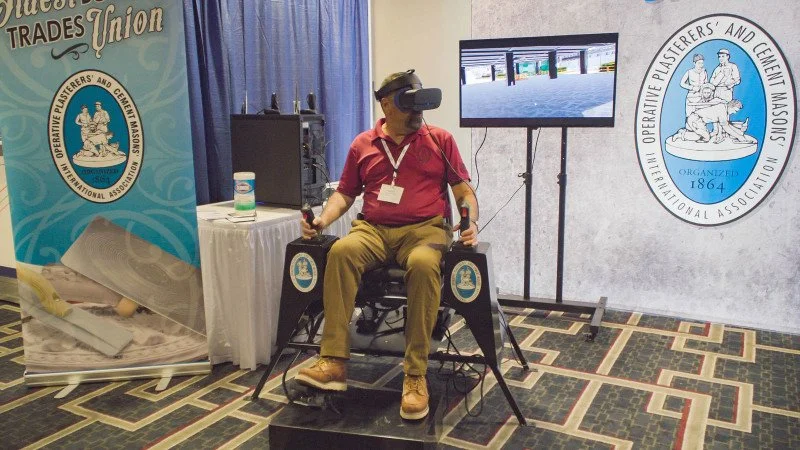
The film follows Wilson, fresh off the end of his HBO show, struggling to find a new creative avenue without the affordance of the HBO technical crew and funding. After attending a real workshop run by the Hallmark Channel on how to pitch and factory-reproduce their films for mass appeal, Wilson is inspired to make a documentary film about concrete. Through his exploration of this ever-present but rarely-questioned material, he finds his way into the Pantheon in Rome, a gum-cleaning business, the set of Marty Supreme, a tattoo preservation company, a grieving rock musician, an bleak L.A. celebrity party, an Ohio driving instructor, a 3,100 mile race around a city block, underground noise gigs, and flooded New York City apartments. Through these vignettes, Wilson finds a common thread of infrastructure failing much of the contemporary population of America, particularly how the easily-produced concrete has not held up over the years. Seeing just how many buildings in New York are hanging by a thread – or often literal masking tape as Wilson demonstrates at one point – is unsurprising, nevertheless terrifying, and saddening in how it plays into the lives of the people who live and work around it. Entire industries exist not just to manufacture concrete but to market it, sell it, and utilise it to destroy creative or environmental initiatives. You’ll be left pondering how you can ever hope to escape this industrialised hellhole we’ve created that is destined to collapse before we know it.
Through all of these threads, Wilson is using a version of his real-life awkward persona (however amplified, you be the judge) to small talk his way through conversations with eccentric American personalities, and it is here where I found the viewing experience most enlightening. I have never seen a John Wilson project with a crowd, so it was illuminating to find that his subjects that I typically find only mildly amusing, sweet, sad, or deeply vulnerable, were found by the crowd to be laugh-out-loud hilarious. I will continue to be uneasy about my feelings on the ethics of showcasing to a crowd the amount of vulnerability Wilson’s subjects display. As he is a peer of docu-comedy scenes that Nathan Fielder, Tim Robinson, Connor O’Malley, and Joe Pera have erupted from over the years, it is not surprising for Wilson to generate the kind of fanbase I witnessed at the screening, though it’s not a fanbase I really exclude myself from. None of this is a definitive “you can’t laugh at Wilson’s work” or “Wilson’s work is funny 100% of the time”, as I think that idiosyncratic combination of the hilarity of and sympathy for eccentricity is key to his work.
It is easy for one’s takeaway of The History of Concrete to be despair. Despair in the face of the industrial revolution’s unsustainable growth and inevitable collapse, the countless disenfranchised people it leaves in its wake, and the ethics of documentary filmmaking. Wilson certainly entertains the possibility that despair is all there is, and is especially critical of how much America’s love of concrete manifests in bizarre patriotic displays seen at concrete expos and bricklaying competitions. But he finds connection, however bizarre, wherever he goes. His earnest curiosity and interest in people and their craft is at the forefront. Like all of Wilson’s works, it’s a film that begins with one thing (concrete) and very quickly becomes about everything, recognising the socio-industrial ecosystem that governs the modern world.
The History of Concrete screened as part of the 74th Melbourne International Film Festival. For more information, click here.
Follow Malachy on Letterboxd and Instagram.