
Images courtesy of Madman Entertainment.
The divided identity of post-war Europe has long fascinated Polish filmmaker Paweł Pawlikowski, taking its most literal form yet in Fatherland, the final installment in his thematic trilogy of monochrome period pieces (along with Ida and Cold War). Examining the partition of Germany after World War II, the director’s latest is an unsparing portrait of a nation torn apart by the competing influences of nationalism and authoritarianism. Pawlikowski argues that there was no true reprieve from fascism after World War II, only pale imitations of its reign.
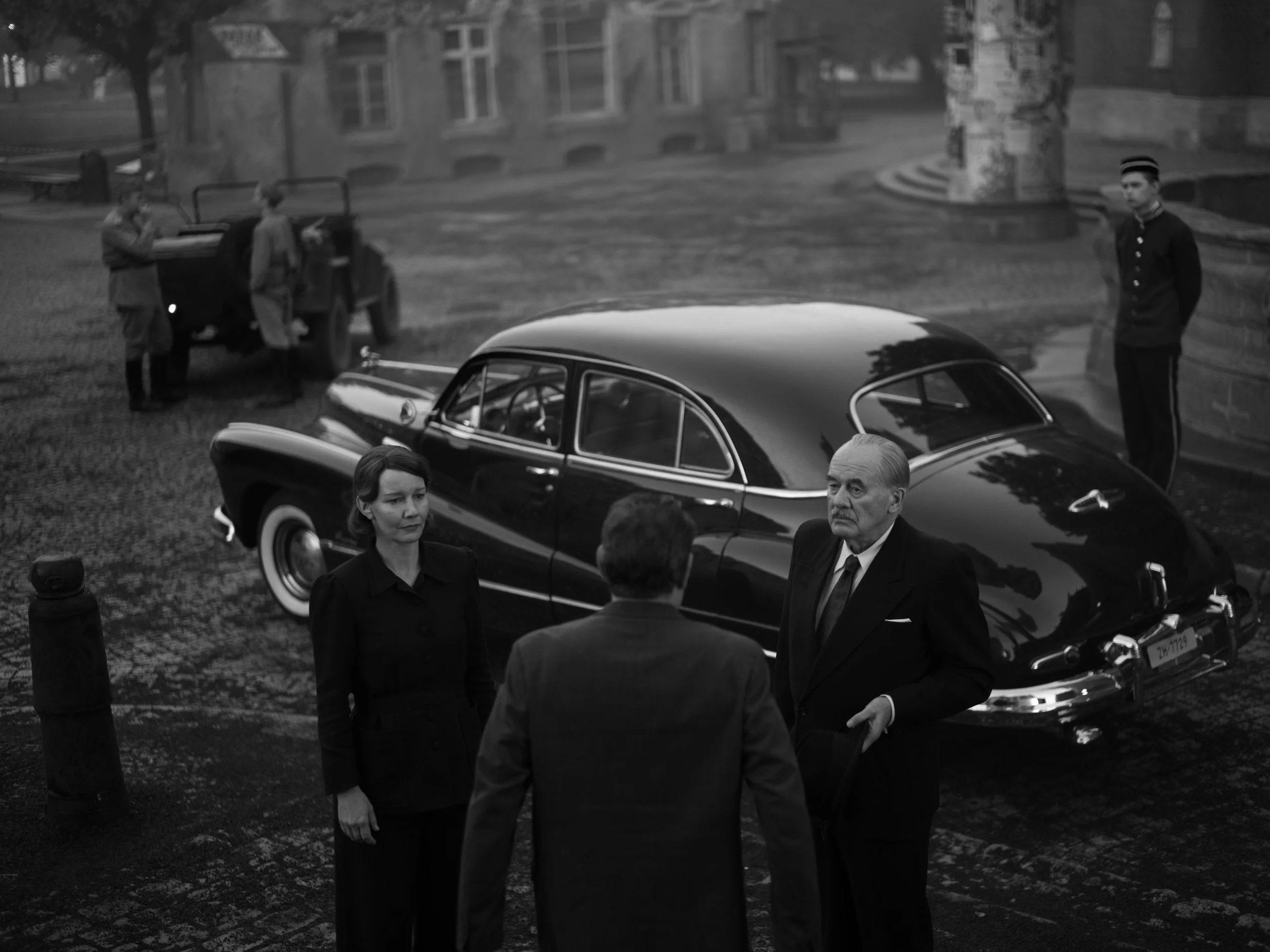
Running at a brisk 82 minutes, Fatherland chronicles the fateful road trip of Nobel Prize winning writer Thomas Mann (Hanns Zischler) from West to East Germany in 1949. Arriving home to accept the prestigious Goethe prize for the first time since Hitler’s rise to power in 1933, Mann and his daughter Erika (Sandra Hüller) quickly come under attack from both communist and Western critics. Amid his relentless political maneuvering and a personal tragedy, Mann’s advocacy for a unified German culture begins to crumble, along with his family. Pawlikowski and his co-writer Hendrik Hanloegten handle all of these conceptual strands with aplomb, undercutting the intellectual justifications for the partition with its stark human impact.
The script’s success is in no small part due to Zischler and Hüller, an engrossing double act who effortlessly veer between brittle and tender in depicting the real-life father and daughter’s volatile rapport. The duo’s core conflict is over Mann’s writerly talents; Erika accuses him of building a “castle of words” to insulate himself from the harsh reality of the new Germany(s). The age of intellectuals may have ended with the Nazis, but the film’s focus is on Mann’s lonely future: both West and East Germany are determined to claim him as a totem of their new “liberated” German cultures, despite their mutual distaste for free thinkers.
That Pawlikowski manages to criticize both sides without resorting to simple centrist platitudes is a testament to his and director of photography Łukasz Żal’s visual consideration. The idealistic promise of the East seems to offer liberation for Mann, but the calculated symmetrical framing of its bureaucrats and totalitarian architecture indicates the new regime isn’t straying too far from the authoritarianism of the Third Reich. Likewise, the West’s glamorous modern facade is quickly tarnished by the presence of former Nazis, allowed to roam free after the Holocaust.
Shot in the boxy traditional Academy ratio, Żal’s composition is as elegant and classically trained as it was in Ida and Cold War. It also recalls his more recent work on Jonathan Glazer’s The Zone of Interest, holding certain characters at a distance to position them as figureheads of a regime. Around the middle of the film, Żal composes a painterly image that encapsulates the film’s entire thesis: Thomas and Erika facing a river in joint mourning, foregrounded by American troops and crowded into the centre of the frame by a smoggy power plant. Returning to a broken country determined to bury its past, both Pawlikowski and Mann find that there is no space left for grief, only an endless advance towards a bleak future.
Fatherland opens in cinemas on Thursday the 12th of November. For more information click here.
Follow Jodie on Instagram and Letterboxd.