
Film Review - The Magic Faraway Tree
Images courtesy of VVS Films.
“I feel like their childhood is slipping away”
Book to movie adaptations are never easy, what with having to condense multiple complex and character driven narratives that would take hours to read into a shorter visual format. On top of that, there’s always the book fans who will read you to filth if you dare ruin their favourite novel (myself included), so I applaud the bravery demonstrated by Simon Farnaby - of 2017 Paddington 2 fame - in transforming Enid Blyton’s famous The Magic Faraway Tree series into a 110 minute live-action children’s fantasy adventure film. Directed by Ben Gregor in a decidedly more modern setting than the books, it follows the Thompson family as they are forced to leave their swanky inner city life and start over again in a ramshackle barn in the countryside where kooky Dad Tim (played by the ever eccentric Andrew Garfield) grew up. Here he works together with his wife Polly (Claire Foy), the engineer and former breadwinner, to actualise their long shelved dream of starting a tomato business. Their three kids, Beth (Delilah Bennett-Cardy), Fran (Billie Gadsdon delivering a stand out performance), and Joe (Phoenix Laroche), are decidedly less on board with their newfound vintage country lifestyle and instead find themselves drawn into the dangerous magical woods nearby that house creatures and lands of various whacky and whimsical forms.
I was a little sceptical when I first heard of the film, having grown up reading The Magic Faraway Tree series with my Mum, who was similarly raised on them. The first book was released in 1939 and stood the test of time for many years - it’s the type of childhood classic that transcended the generational divide, raising children from the Silent Generation to Gen Z. However, at its core, it read more like a series of short stories that contained a set group of main characters as they interacted with various magical worlds. Undoubtedly entertaining, borderline repetitive, morally heavy-handed but not something innately Big Screen worthy. Unsurprisingly, a few changes were made in order to attract a more modern audience, most notably in using the newly revised book edition names for the children, such as Fran - unfortunately Fanny has a very different connotation to it now than it did back in the 40s. But whilst the movie starts in a decidedly modern time, with Polly quitting her job over her company using her engineered fridges to spy on consumers, it critiques the effect of modern luxury on childhood before pivoting to the timeless nature of the British Countryside. Their new home is not only Wi-Fi–free, but entirely without modern amenities such as running water or electricity.
The kids are, rightfully, upset about their new barn-living situation, yet their reactions to the ‘real world’ around them were entirely over-the-top and ridiculous. It felt like a thinly-veiled, boomer-style jab at how ‘soft’ modern kids are, talking down to the audience and risking alienating the very children the film is trying to inspire to embrace boredom and creativity in the age of constant stimulation. The film only really finds its footing once Fran discovers the Magic Faraway Tree, bringing to life the whimsical and nonsensical nature of the original books. It was a beautiful representation of the wonder and the creativity it encouraged when reading as a child.
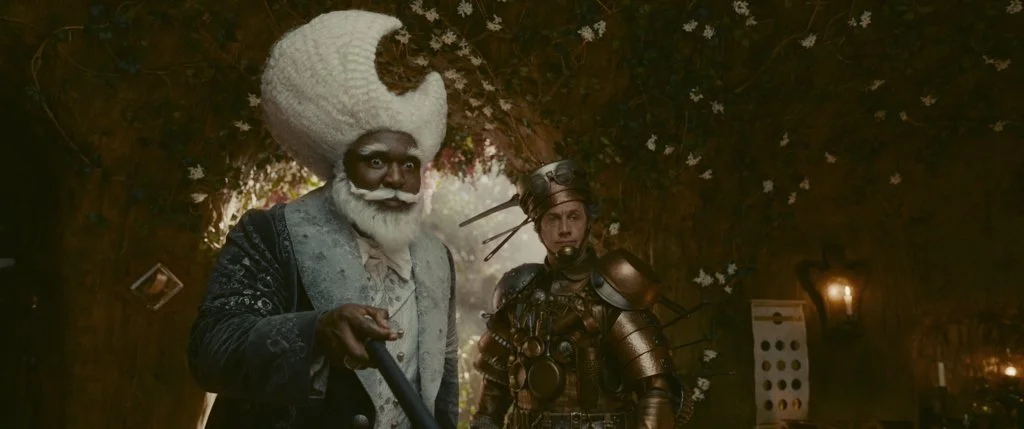
All the magical creatures of the Tree were stunning, with Nicola Coughlan’s Silky and Nonso Anomie’s Moonface particularly standing out as well-rounded, absurdist characters with human flaws. Whilst I was a little disappointed that Moonface lacked his traditionally literal Moon-shaped face, I must say I definitely appreciated the creative reinterpretation in making his hair the shape of a child’s drawing of a moon. The first shot of Fran discovering the tree was an absolute masterpiece in movie magic - a slow build up coupled with fantastic lighting, over the top colours (none of that grey scaling that’s taking over modern filmmaking), and absolutely wondrous to its core. After that, the human world scenes also seemed to straighten out, hitting the right balance of whimsy and realism.
The initial portrayal of the stay-at-home dad as a bumbling fool felt like a political choice, especially given existing stereotypes. Given today’s political climate, with the rise of “trad wives”, incels, and the Gilead-ification of the West, it comes across as a little careless. I dread to think of Tim’s childlike wonder being co-opted by certain groups to promote a reductive view of fatherhood. Especially when coupled with Beth’s very heavy-handed, almost caricatured portrayal of feminism in the first half of the film. It seemed like an overcorrection to the original novels’ rigid gender roles, which rightfully needed to be addressed in a modern setting, but the attempt just came off as a little preachy and contrived, given Beth was framed so negatively from the start it completely undermines her understandably critical perspective and views not only of their new farm life but on some of the more questionable features of The Magic Faraway Tree society.
Nonetheless, the film’s themes of childhood’s fleeting magic, Farnaby’s clever weaving of the fantastical treetop world into the broader tomato-harvesting storyline, as well as the insight into Tim’s own childhood (allowing Garfield to develop a more three-dimensional character) make it well worth sticking through the troubling first act.
So if you’re into the whimsy of childhood, fun cinematography, quirky plot lines, and family reconnection then The Magic Faraway Tree is the film for you!
3.5 out of 5 pop biscuits.
The Magic Faraway Tree is screening in cinemas now. For tickets and more info, click here.