
MIFF 2025 Film Review - Les Rendez-vous d’Anna
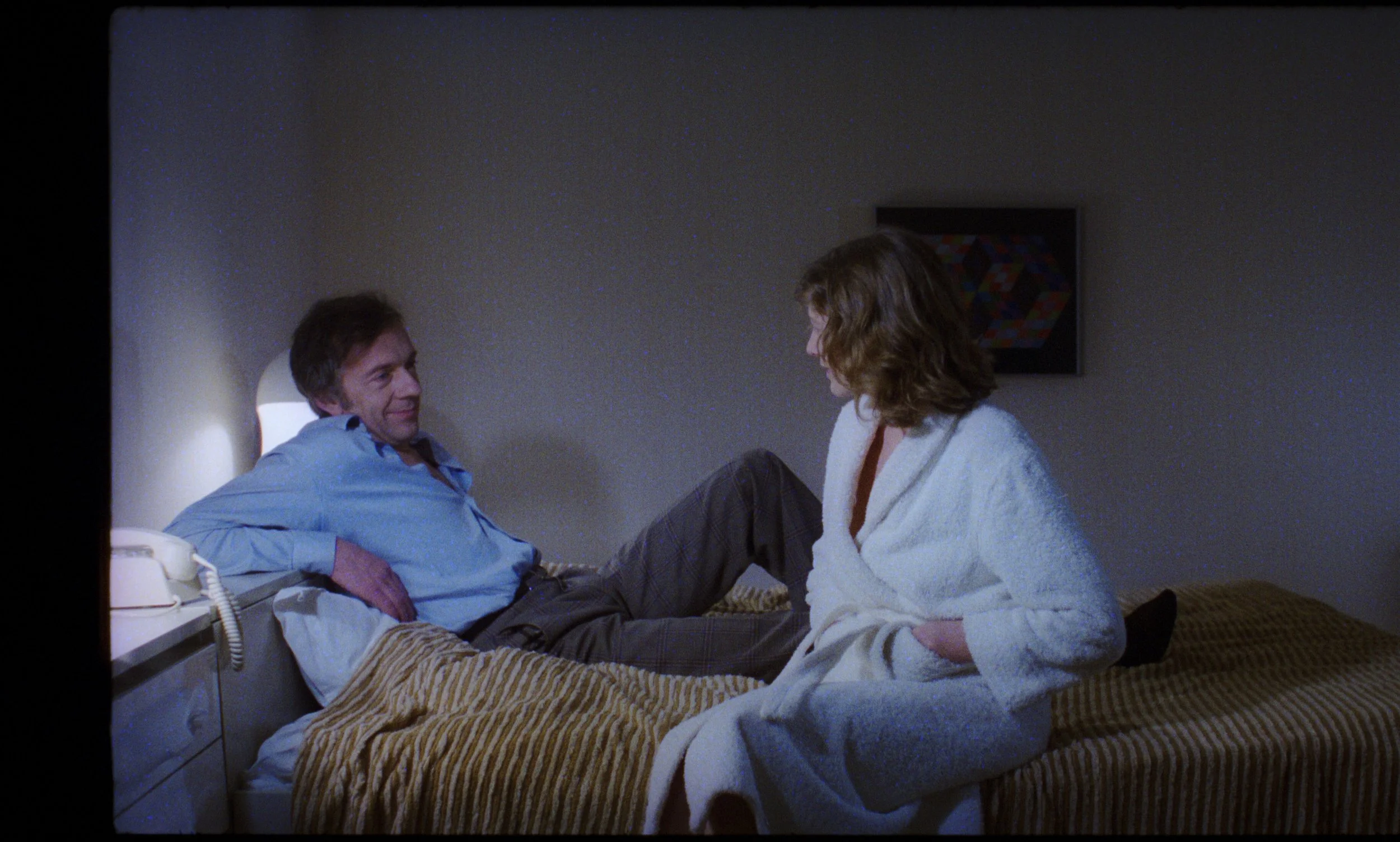
Images courtesy of Common State.
Like most, I was introduced to Chantal Akerman through Jeanne Dielman, 23, quai du Commerce, 1080 Bruxelles (1975), which over the past decade has been rapidly venerated as integral to the cinematic canon. I still really like Jeanne Dielman, but delving into Akerman even further this year since Melbourne Cinematheque’s screening of the rare A Couch in New York (1996) and subsequent entries in my own time–and now MIFF’s brilliant and thorough retrospective on her career–has had me falling head over heels with her deeply personable approach to every little thing she does in her films, and Les Rendez-vous d'Anna (1978) is perhaps my new favourite film of hers. Les Rendez-vous d'Anna follows the tranquil, lonely odyssey of Anna Silver (Aurore Clément), a filmmaker travelling across Western Europe to promote her new film. Amidst her lengthy transit, she meets and converses with various friends, lovers, and relatives, including a one night stand in Cologne (Helmut Griem), her ex-fiancee’s mother at a station (Magali Noël), a stranger on a train (Hanns Zischler), her mother (Lea Massari), her ex-fiancee (Jean-Pierre Cassel), and finally, the trapping comfort of her own home.
Les Rendez-vous d'Anna takes place almost entirely in liminal spaces–hotels, taxis, trains, footpaths and railway stations. As a travelling filmmaker, Anna is continually displaced from any physical sense of home. Les Rendez-vous d'Anna contains one of the most mesmerising sequences of railway travel I have ever seen depicted in a film, as Anna travels from Cologne, West Germany to Brussels then to Paris in a sequence that felt like it went for an hour, which I mean in the best way possible. Her characteristic dreamy long takes feel purpose-designed to film a railway commute, with even the narration from passenger Hans (Hanns Zischler) complimenting the movements of the train as it is reconfigured at a station. This is not the first time Akerman has explored liminal realities–Hotel Monterey (1973) similarly embodies the architectural and almost communal loneliness of hotels in a very similar way to Les Rendez-vous d'Anna. But another important thing to note here is that Hotel Monterey is Akerman discovering herself amidst the pulsating chaos of her then-recent move to New York from Brussels, a move often brought up in other films such as News from Home (1976). In Les Rendez-vous d'Anna, it is as if Akerman is returning to her home in Europe and finding that same alienation. It’s important to note that, like most of Akerman's films, Les Rendez-vous d'Anna is semi-autobiographical, however here it is to a very explicit degree. Akerman’s middle name was Anne, after all.
Having seen many of her own films that Akerman has starred in, it’s almost as if Clément is channeling her with her performance, which she plays with such an entrancing aloofness, even beyond the one-sided nature of most of her conversations in the film. A German man monologues to her about his plight within a divided country in political turmoil–the fluctuating state of Europe comes up a lot in the film–a railway passenger explores his ongoing treks around European cities on the basis of selfishly finding romance, and her ex-fiancee’s mother guilt-trips her about needing to find a man over continuing her career, something Akerman fundamentally opposed. It is when Anna meets her mother that the film’s personal portrait status really comes into play.
Anna tells her mother–whom she has met in a hotel room to avoid her father–about a one-night stand she had with a woman in Italy during a recent tour of her film, finishing the story with “...for some strange reason, I thought of you,” effectively equating the intimacy of this experience with that of the love she craves from her mother. This conversation works not in spite of its incestuous implications, but because it functions as this really moving and stirring moment of openness between Anna and her mother, especially moving knowing how Akerman’s relationship to her mother is a beautifully totemic part of her films. Akerman’s identity as a lesbian is also equally important to note here. Anna’s fling with this woman in Italy has largely held her above water for much of her trip, being one of a few genuine connections she has made on a trip otherwise ripe with condescending men and women alike who push heteronormative, family unit-oriented standards upon her. It is also notably the only conversation in the film where Anna is doing most of the talking.
As a result of her queer identity, Akerman’s films often explore the antagonistic relationships she has with men. After Anna departs from her mother, she meets her ex-fiancee Daniel in, you guessed it, a hotel, a successful businessman who nonetheless has never gotten over Anna, wallowing in this self-pitying despair of yearn. Jean-Pierre Cassel, one of France’s all-time biggest actors, suitably plays Daniel as though he were a worm. Anna entertains his attempts at rejuvenation but it becomes clear as this scene continues that the two, who seemingly had their engagement arranged for them from childhood primarily by Daniel’s mother, are going through painfully artificial movements of sexual being. Probably one of the film’s most striking moments is Anna, naked, lying on-top of a fully-clothed Daniel, the latter of whom does not want to have sex but merely wants her presence almost as a blanket, and it is hard not to view Daniel’s hollow attempts at intimacy as pathetic, but it is doubtful that Akerman is not at least a little sympathetic towards this character.
The film ends with Anna returning home, the first time we see a location that is not a liminal space, but this is not to say anything has changed–Anna endures a sequence of answering machine messages telling her all of the cities she is required at for the next few weeks, with her hotels, of course, all fully booked for her. Anna then listens to a message from the woman she had a one-night stand with in Italy, her name revealed to be Claire, who has been trying to contact Anna ever since. Anna responds to none of the messages. Within this long take, Clément lies motionlessly on her bed, still in her jacket and shoes, holding this blank yet saddening gaze that eerily feels as though it is pointed straight at the camera. Although she is home, this silent gaze indicates that her tribulations may never be over.
Follow Malachy on Letterboxd and Instagram.
Les Rendez-vous d’Anna screened as part of the 2025 Melbourne International Film Festival. For more info, click here.