
MIFF 2026 - Blue Heron Review: A Grief-Stricken Tour De Force
Images courtesy of Janus Films.
“As time passes, the ritual exchanges between adults become less frequent… By the time they finally leave the colony, these bonds will have completely disappeared,” a wildlife guide drones offscreen in the opening moments of Blue Heron. It’s a not-so-subtle hint at the significance of the titular bird, an emblem of the familial fracturing soon to come. But for a film so dense with figurative language and imagery, what’s most startling about Blue Heron is its emotional directness. As intellectually rigorous as filmmaker Sophy Romvari’s examination of time and nostalgia becomes, it’s all in service of capturing the truly indescribable sensation of decades-long grief.
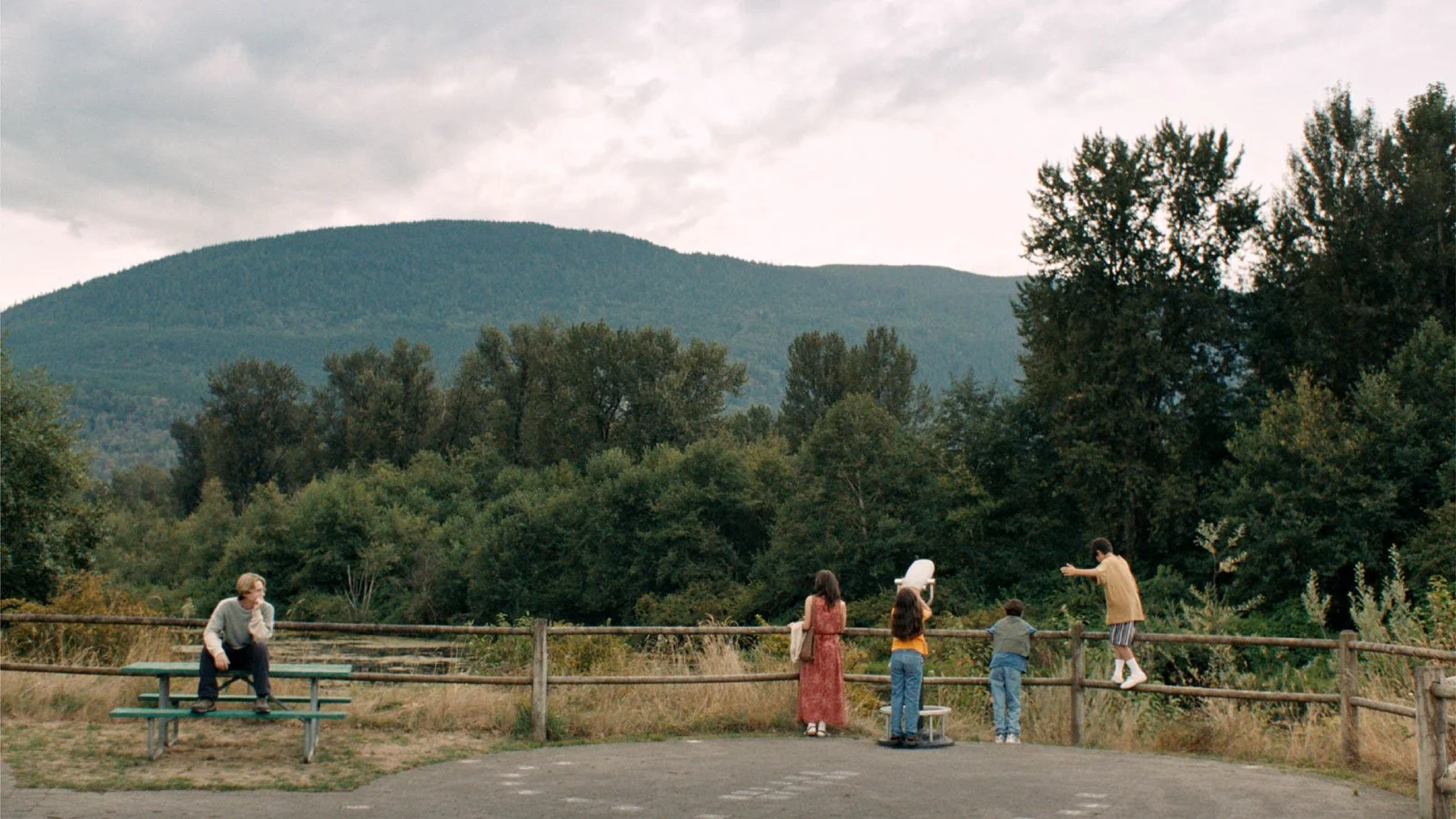
The Canadian writer-director has made no secret about the personal nature of her storytelling. Her short film Still Processing documented the loss of her two older brothers, deliberately communicating most of its exposition through subtitles instead of speech. This artistic maxim, that “there are some things that cannot be said out loud” continues in Blue Heron, which unfolds over a tumultuous summer in late ’90s Vancouver Island. Despite following a family of six, the narrative largely unfolds through the naive eyes of its youngest daughter Sasha (Eylul Guven). This means that the increasingly erratic behaviour of the oldest, Jeremy (Edik Beddoes), only appears onscreen in contextless fits and starts. As does the tension between Sasha’s unnamed parents (Iringó Réti and Ádám Tompa), whose hushed arguments grow louder while Jeremy’s mental state deteriorates.
The domestic conflict of Blue Heron will feel painfully familiar to anyone who’s helplessly watched a loved one struggle with mental health issues. Romvari enhances the emotion through her sparse use of dialogue in the film’s first act, directing the audience’s attention to her actors’ strained expressions and body language. In one particularly inspired shot, cinematographer Maya Bankovic lingers on Réti’s clenched fists kneading potato cakes. Frustration permeates every frame of the film: Jeremy remains undiagnosed, untreated and unheard by the very system supposed to help him. Early on, a patronising psychologist dismisses his condition as just another case of “oppositional defiant disorder”. At the film’s heart is the difficult truth that you can do everything in your power to try to save someone’s life, and still fail.
As affecting as this kitchen sink drama is, the film’s self-reflexive finale brings Romvari’s broader thesis into focus. How do you accurately tell such a sensitive story from childhood, without offering up an easy resolution? She arrives at an answer that bypasses reenactment, bending time to her will for a sublime reckoning with personal guilt. Unlike so many other filmmakers’ recreations of their troubled childhoods, Romvari’s core concern isn’t magically fixing her loss through fiction, but simply conveying its unyielding weight. The exact moment of Jeremy’s passing isn’t the sole centre of her grief; it ripples through her past and future infinitely. “I wish I could have done more to help you,” Romvari lamented to her brother in Still Processing. Blue Heron mourns an entire family lost to this regret.
Blue Heron screened as part of the 74th Melbourne International Film Festival. For more information, click here.
Follow Jodie on Instagram and Letterboxd.