
I Want Your Sex Review: A Love Letter to Gen Z That Chokes On Its Own Story
Images courtesy of VVS Films.
For what is meant to be a ‘sex-positive love letter to Gen Z’, Araki spends a lot of time making his younger characters suffer in I Want Your Sex, his first feature in over a decade.
I Want Your Sex displays Araki’s typical erotic storytelling and exploration of sexuality, yet it falls flat in comparison to his earlier work in the nineties. His intention with the film is undoubtedly clear. He goes as far as explicitly explaining it through a brief monologue given by Olivia Wilde’s character, Erika Tracey, about how Gen Z is just not having sex and we’re wasting our ‘sexual prime’.
Araki tries to implore young people to go forth and fuck, consequences be damned. He pleads with his audience to embrace the hedonistic pleasures of life and learn to be intimate with one another. The film was supposed to normalise anxiety around sex and encourage the viewers to try anyway. Only Araki’s well-intentioned hope deflates under the weight of the main narrative.
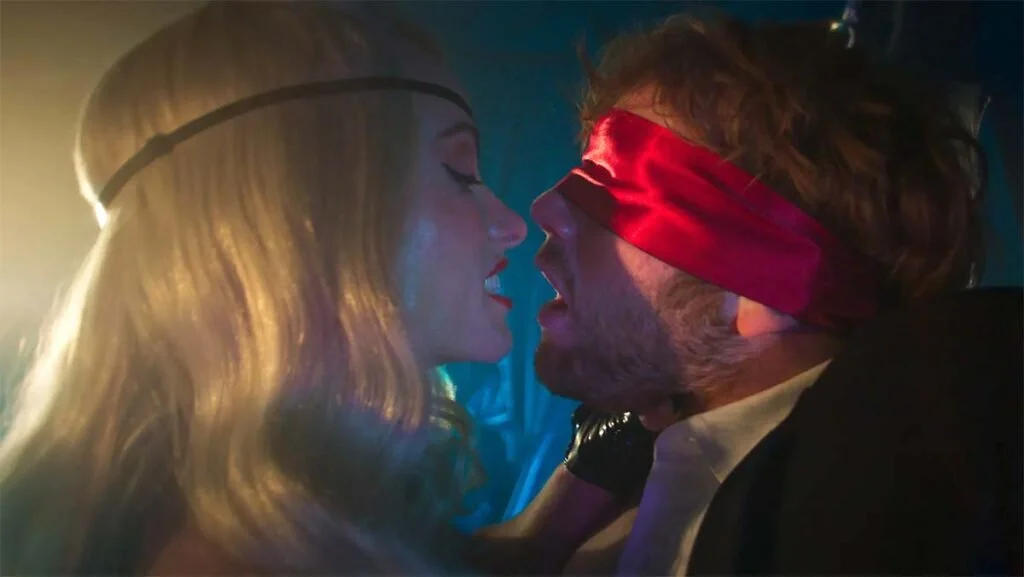
The film follows Elliot Bell (Cooper Hoffman) as he begins an internship at Erika Tracey’s art gallery. Soon after, they begin a sexual relationship. I Want Your Sex is marketed as a raunchy comedy about a disenfranchised young man who finds rejuvenation through sexual discovery. Yet, personally, the film worked better as a satire of the contemporary arts industry than a social commentary on differing generational perspectives about sex.
The scenes where Tracey delivers incredible one-liners about her useless work as a famous artist or makes off-handed comments about hoping she isn’t paying Bell too much as an intern were the highlights of the film. Araki encapsulates the pretentious yet meaningless world of high-end art in a brilliantly sardonic manner. If the film had been focused on that, it would have been an immediate recommendation for fans of I Love LA and Adults.
However, I Want Your Sex is obviously centred on sex and Bell’s obsession with Tracey despite her obvious detachment. The film fails to achieve Araki’s hope to endorse sex-positivity because from the beginning, its main relationship is not about exploration, but rather exploitation. Tracey is an unflinchingly candid woman interested in dominating Bell purely for her own gratification, manipulating her position as Bell’s boss and his only source of income. It is textbook sexual coercion and a striking power imbalance that makes Bell a victim of abuse.
As a result, I Want Your Sex struggles to inspire Gen Z as its focal point is too toxic to support and the two subplots that actually make intriguing cases for sexual exploration are pushed to the wayside. Bell’s housemate Apple (Chase Sui Wonders) has a sparkling appearance within the film where they navigate new sexual preferences only to endure a heartbreaking introduction to sapphic desire and promptly disappear from the story. A similar fate is given to Mason Gooding’s character who only acts as the stereotypical sassy gay man with no other personality traits despite being the only Gen Z character who actively expresses his sexual promiscuity.
Araki contradicts himself in lamenting Gen Z’s low libido by having these characters that both explicitly want sex, have sex, and explore their preferences. The film almost read like an excuse to criticise young people for experiencing a different relationship with intimacy in comparison to the generations before us. It is understandable that from the outside, the situation may look concerning. However, I would argue, in a generation that is consistently being surveilled and criticised publicly, it is common to not want to discuss sex as organically as one did in the generations before. Neither is more correct, only different and a reaction to their socio-political climates. However, this film felt as if Araki believed one was correct and as someone from Gen Z, it only made my eyes roll.
Additionally, I Want Your Sex has an absolutely stacked cast from Olivia Wilde to Charli XCX. Every performance was exceptional, especially Wilde who genuinely seemed to be having the time of her life in the role. The humour was biting, never once shying away from being brutally honest about the art industry and society as a whole.
I am certain Araki will get his wish for stimulating conversation, as I truly believe everyone who watches this film will have plenty of ideas to share. But Araki’s love letter only consisted of empty platitudes that were limply executed. You cannot generalise an entire generation’s relationship with sex in one film, especially when there are no redeemable characters to root for. I Want Your Sex just seemed like an excuse for Araki to put a grown man in bloomers and try to relive his glory days.
I Want Your Sex is screening in cinemas from Thursday the 27th of August. For more tickets and information, click here.