
Images courtesy of Vendetta Films.
In 1859, young Māori woman Mary Stevens (Ariāna Osborne) travels from Aotearoa to England after receiving a letter that promises to reveal secrets about her family history. Upon arrival, the sender is missing, but the local lord Nathaniel Cole (Toby Stephens) hires her to work as a governess for his niece (Evelyn Towersey) and live in his opulent manor. Nathaniel welcomes Mary and boasts about his collection of Māori artefacts and fluency in the language, but the longer Mary spends at the manor, the more she uncovers buried secrets about Nathaniel’s intentions and her own history. An impressive debut, Mārama toes the line between telling a powerful, respectful and nuanced story about the destructive effects of colonisation, while retaining the brisk pace, supernatural thrills and trademark shocking violence of a genuine genre film.
Much that has been written about the film paints it as a brutal and bloody story of postcolonial revenge and feminine rage. While these are both huge aspects, the film takes a very careful and measured approach, never indulging in revenge-film or horror cliches of gratuitous, over-the-top violence. This isn’t to say that the violence included isn’t intensely cathartic, because it one hundred percent is, but rather that it maintains its impact through the film’s approach to perspective. Mārama successfully distances itself from exploitation by centring Mārama’s (Mary’s Māori birthname) grief, offering a refined, heartfelt perspective on the horrors of colonialism, even when touching on some very heavy topics—this is a film that should come with just about every content warning in the book.
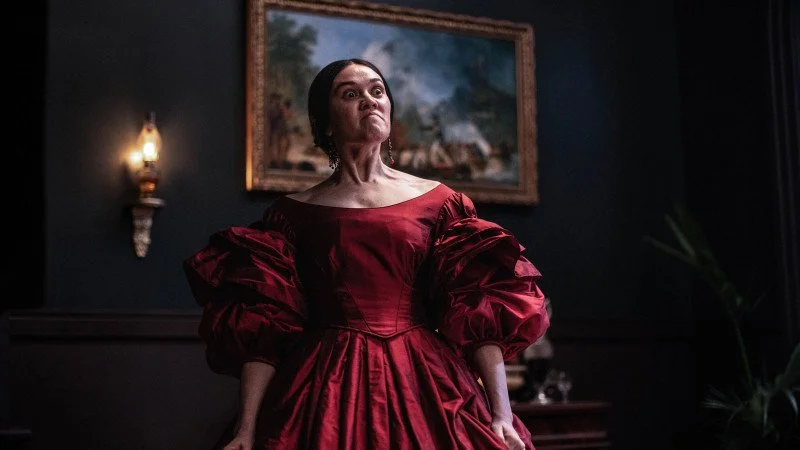
Despite being a low-budget debut indie feature, Mārama still achieves an exceptional and effectively spooky look. The central English manor and its gardens are a visual feast, with production design that serves to subtly box both Mārama and the viewer in, surrounding them with ostensibly innocent but deeply abhorrent colonial artworks and other markers of sickening extravagance. Sticking out like a sore thumb in the manor is Peggy (Umi Myers), Nathaniel’s Māori housemaid who, unlike Mārama, has had her culture entirely stripped away, and is subjected to Nathaniel’s frequent sexual assaults. Also deliberately out of place is a massive traditional wharenui, a sacred Māori hut that is said to represent the physical body of a tribal ancestor. Picked apart in Aotearoa and shipped over to act as a mere lawn ornament for this English lord, the wharenui acts as a tragic symbol for colonisation as a whole.
This exact type of oblivious cultural disrespect is shown repeatedly throughout the film, as Nathaniel and his right-hand man Jack (Erroll Shand) proudly show off their artefacts and knowledge to Mārama under the guise of respect and admiration for Māori culture, which they were both surrounded by during a time as whalers in the region. As a film, Mārama never attempts to hold the viewer’s hand—the Englishmen’s cultural insensitivity is never explicitly called out or explained by Mārama, but their words and actions are instead mirrored by her constant, mounting disgust and rage. Stappard’s total faith in Osborne’s portrayal proves to be a winning gamble; the young actor delivers a truly breathtaking performance, worthy of all the praise it will inevitably receive as the film meets a larger audience.
Osborne’s performance and the themes of cultural disrespect are highlighted most prominently in what is arguably the film’s most show-stopping moment—Mārama’s haka, delivered with vicious, palpable fury in response to a theatrical haka performed by Jack for his affluent friends. It is a deafening, impassioned reclamation of her desecrated culture which, without subtitles or explanation, serves as the ultimate reminder that these wealthy Englishmen have no real respect for Māori culture, only a colonial desire to plunder it for themselves and seem more intellectual or “exotic” than they truly are.
The most common complaint gleaned from other reviews has been the plot’s complexity and lack of straightforward unfolding. Personally, I found the central mystery’s kaleidoscopic nature to be effective at mirroring Mārama’s own experience in slowly piecing together her family’s dark history, which has been occluded and concealed by the brutality of colonisation. For a 90-minute genre flick, its labyrinthine presentation was perfect and even inspires repeat viewings, where scenes will take on whole new meanings given the revelations in the film’s third act.
Though it may not receive a wide theatrical release in Australia, look out for this film if it is playing near you or when it appears on digital platforms—Mārama is an instant modern horror classic, a masterpiece of indigenous storytelling, and deserves as much praise and recognition as other recent horror movies from this part of the world such as Talk to Me, Bring Her Back and Leviticus.
Follow Harvey on Letterboxd and Instagram.
Mārama screened as part of the 74th Melbourne International Film Festival. For more information, click here.