
Images courtesy of Blue Finch.
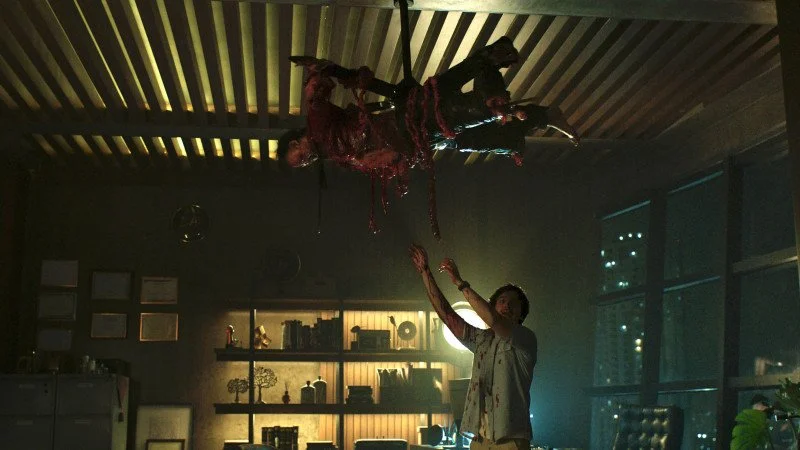
Joko Anwar’s Ghost in the Cell, as is clear from its title, is a very tongue-in-cheek horror film. Its conspiratorial opening scene, where meek reporter Dimas (Endy Arfian) is investigating a case of government coverup and corruption, is cut short when his boss is brutally murdered by an unseen supernatural force. The victim’s horrifically disfigured body is displayed, hanging from a ceiling fan, in such gutsy and gory fashion that it can only be described as a perverted piece of art—this image is soon pasted over with a deliciously 70s, grindhouse-style titlecard, telling audiences exactly what to expect of the next 100 minutes.
Dimas finds himself wrongfully accused of the murder and thrown into a Jakarta prison where corruption is rampant—head guard Jefri (Bront Palarae) takes sadistic satisfaction from abusing the prisoners and orating at length about his superiority, while the warden Sapto (Kiki Narendra) spends his time buttering up government-official inmates in premium prison cells who can come and go as they please. Brutal violence among prison gangs is widespread, so Dimas quickly falls in with a merry band of outcasts, most of them scammers and petty thieves, run by the good-natured and rebellious Anggoro (Abimana Aryasatya), arguably the film’s protagonist. Soon after Dimas’ arrival, more mysterious deaths begin occurring, and the inmates soon find themselves pitted against a creatively violent vengeful ghost that feeds off anger and negative energy.
Despite its spooky premise and constant threat of danger, Ghost in the Cell manages to be nothing short of a hilarious thrill ride. Comedy is injected literally wherever it will fit—for one of many examples, Anwar will have one character poke his head around a corner, followed by another, and another, until ten people are inconspicuously peeking to create a truly ridiculous image. With a less talented cast and writer/director, the film could feel overstuffed or heavily reliant on comedic moments that fall flat, but that is far from the case here. Every cast member stands out in the ensemble, combining heightened physicality with authentic, believable fear of their ridiculous situations to hilarious effect. Once characters learn that the ghost is targeting people overwhelmed with negativity, the lovable skeptic-turned-psychic Six (Yoga Pratama) theorises that engaging in loving activities such as cleaning, praying or dancing can keep one out of harm’s way. This results in a gamut of scenes throughout the film where inmate gangfights are interrupted by outbursts of religious fervor and straight-faced dance fever, a combination that never fails to elicit a hysterical response.
While comedy plays a large role, Anwar stays true to his gruesome horror roots and doesn’t skimp on creative kills and some truly stomach-churning gore effects. Each of the ghost’s victims is left in an almost unrecognisable state, blurring the line between brutality and beauty to deliver some seriously creative “artworks” that incorporate elements of the room where the killing took place. A distinct love for the genre is on display with each artwork, which has clearly been painstakingly crafted by the crew with genuine creativity, practical gore effects, and copious amounts of fake blood—desecrated corpses are displayed impaled on a prison showerhead, wrapped horrifically around a kitchen stove, among many more inventive dioramas. As the film prioritises a lighter tone, there is a lack of distinctly “scary” scenes or out-and-out supernatural spooks, but the shocking gore and disturbing imagery more than makes up for a shortage of traditional scares.
Ghost in the Cell seems to be mainly interested in using its prison setting, which Anwar describes as a microcosm of wider society, to poke fun at different aspects of Indonesian culture such as politics, widespread corruption, socioeconomic class division, crime and scamming culture, religion, and even sexuality. To save themselves, we watch violent criminals turn to Islam for instant salvation, before quitting because “the Qur’an is too hard” and turning to Christianity instead. The dialogue is played totally straight, but these moments of off-hand satirical commentary are peppered throughout the film at every turn, to great comedic effect.
Though some of the film’s heavier messaging and social commentary may fall flat due to its preoccupation with comedy, it manages to strike an even tone, and its relatively shallow critiques of Indonesian society work fine for the kind of film it is—a silly, gory, funny exploitation flick. There are some slight pacing issues in the first act and it may take a while to get to its main conceit, but the cast are so engaging and likeable, and it is so stacked with energy and hilarious moments, that it’s hard to say a negative word about a single minute of this film. Joko Anwar continues to be a prolific filmmaker across all genres, and while he doesn’t always stick the landing, with Ghost in the Cell he has made a huge hit. It is a great ensemble piece filled with action, genuine comedy, incredible gore effects, and a meaningful commentary on corruption and empathy.
Follow Harvey on Letterboxd and Instagram.
Ghost in the Cell screened as part of the 74th Melbourne International Film Festival. For more information, click here.