
MIFF 2026 - Minotaur Review: A Tale of Two Halves in this Award-Winning Political Thriller
Images courtesy of Palace Films.
Huzzah! said the cinephile when Minotaur was announced for the 2026 Cannes Film Festival. This is filmmaker Andrey Zvyagintsev’s first directed feature film in nine years, and his fourth film in a row to premiere and be awarded at the Cannes Film Festival. Zvyagintsev was bestowed the second-highest prize of the festival: the Grand Prix. Perhaps more important to a local audience, though, Minotaur was awarded the Sydney Film Prize at the Sydney Film Festival just last month, before landing here in Melbourne for the Melbourne International Film Festival. And huzzah! this Melbourne cinephile said, though perhaps a bit too early…
Like most of Zvyagintsev’s previous work, Minotaur is deeply infused with Russian politics. Set in 2022, Gleb (Dmitriy Mazurov) is a powerful mogul whose business is thrown into disarray by Russia’s invasion of Ukraine, as he must decide which of his employees he must send for military service. This, however, is only one of the stressful events in Gleb's life, as the film is based upon Claude Chabrol’s 1969 film La Femme infidèle (The Unfaithful Wife). Gleb has been distant from his wife Galina (Iris Lebedeva) for some time, long enough that she has found someone else to confide in: a photographer named Anton (Yuriy Zavalnyouk). He gives her what Gleb can not: exciting texts and sexy photoshoots. These concurrent life events, along with the task of raising a young son, all make it seem to Gleb that his world is caving in. He is the titular Minotaur, half man, half angry beast, inside a labyrinth of political and corporate order that he can not escape.
The film itself is a labyrinth, one built very slowly, brought on by a first half I desperately tried not to write off early. Nothing really grabbed me, and some long scenes — the drawn out hallways in this now dwindling maze metaphor — such as one in which Gleb, Galina, and their friends go out for dinner and drinks, are a chore to get through; clunky stretches of dialogue that supply pointless exposition and feel like dead ends.
It is the infidel storyline that is the intriguing part of the film. Zvyagintsev’s choice to make it explicitly clear that Galina has been unfaithful is far more interesting than pretending she might not be. This is clear from the beginning, as Gleb watches Galina shrouded in the darkness of her unlit home, illuminated only by her phone; a wide smile across her face. It’s not a story of if, or perhaps even why Galina has made this choice, but one of how and when Gleb will react.
Lebedeva really sells the whole thing playing Galina. Her few small moments alone in the film are great, the strong emotional range she supplies make her a voice of reason to the story, cold to her husband, more than justified in being so. Gleb is an unsympathetic protagonist, a symbol of power in a male-dominated environment; without Galina’s presence in the story, it’d be even harder to watch a film led by him.
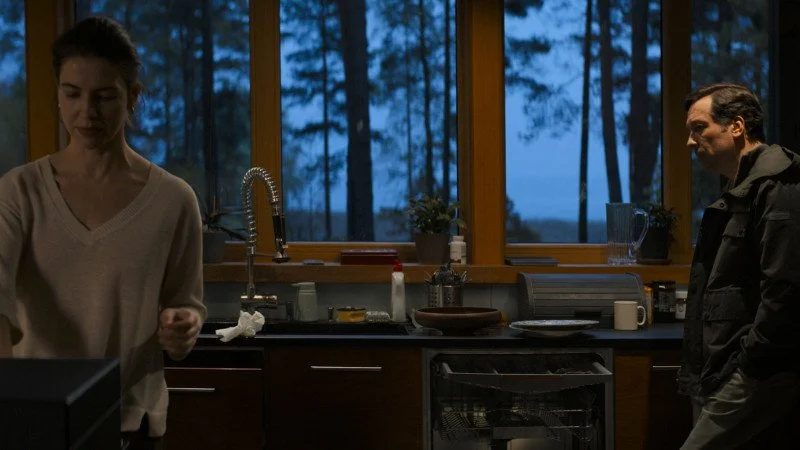
To match its world, Zvyagintsev chooses a bleak look for Minotaur, establishing a sad blue wash to grace itself all over the frame to accentuate the sorrow of the films narrative. There are times when the film is shot in darkness, its characters illuminated by natural light only. I can understand the choice, but after a while the visual style becomes boring; any shade of green now a sight for sore eyes. Though in defense of the film’s visuals, it makes use of some great wide shots, with things to look upon in every corner of the screen. These work very well, with the film's long takes; Zvyagintsev’s camera set up in the middle of a room for the slow burn to take place in real time. It contributes heavily to the film's slow pace but equally to its tense atmosphere.
To escape Minotaur’s labyrinth, though, all one needs to do is get to a certain moment in the film’s midpoint, a moment I will not describe—though anyone who watches the film will know what I mean as soon as it happens—in which the film firmly switches from the slower first half to a quicker, more exciting second. It’s by far the film's highlight, a long sequence that I’m sure the film was planned around, the moment that made me sit up in my chair and finally want to see where the film was going. Finally, halfway into the film, Minotaur became worth it.
But of course Minotaur was still a slog to sit through for a portion of its time. There’s an enjoyable thriller in it, but that comes from the really great stretch in its second half. It does however suffer from the old Return of the King problem: too many endings—but that stretch in the second half is certainly still worth it. No matter the film's quality, though, Andrey Zvyagintsev is making movies again, returning from a COVID-related sickness that very almost killed him, and that’s far more important.
Follow Kayne on Letterboxd and Instagram.
Minotaur is screening at the Melbourne International Film Festival on Saturday the 22nd of August. For tickets and more info, click here.