
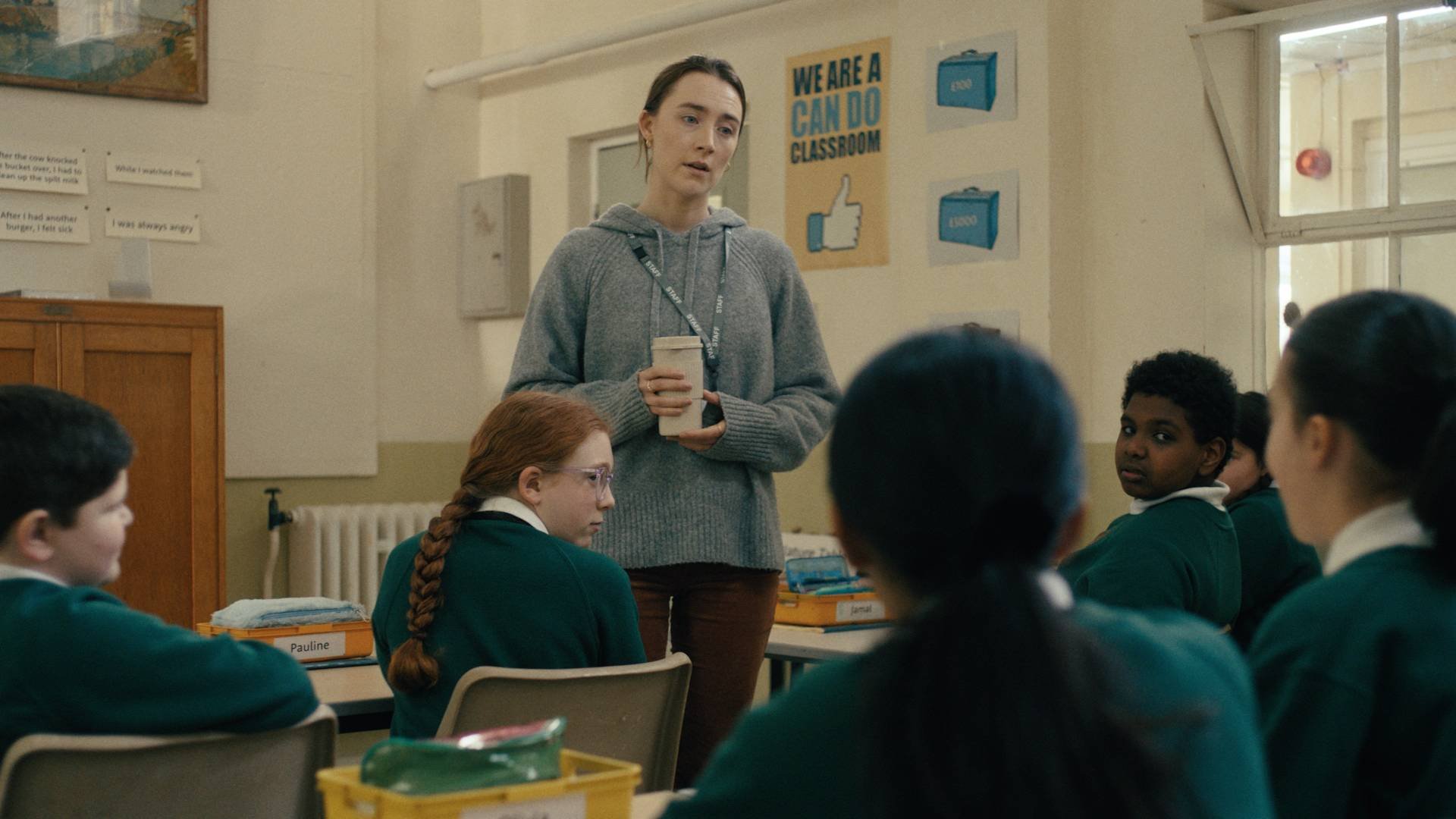
Images courtesy of Vice Studios.
Bad Apples appeals to a distinctly British sense of humour, revealing its charm in the absurd unravelling of its story. The impossible premise of primary school teacher Maria (Saoirse Ronan) imprisoning an especially disruptive student provides fertile ground for an eccentric ensemble of characters and a delightfully dark, quirky sense of humour. Director Jonatan Etzler balances shock and humour with ease but struggles to thread in the more peripheral ideas. Despite the film’s considerable strengths, Bad Apples feels almost incomplete, lingering on the edge of its full potential.
Etzler’s second directorial feature premiered at TIFF in 2025, before appearing in lineups of other major film festivals, and subsequently screening in the Russell Hobbs British Film Festival 2026. The film’s appeal rests largely on the shoulders of Saoirse Ronan who provides an unsurprisingly excellent performance. Ronan carries the narrative’s beats with an expressive subtlety; her natural portrayal steals every scene but never overpowers the film’s other assets. Maria’s spectrum of emotion is impressively conveyed in the slightest shifts in facial expressions, with the last scene relying only on Ronan’s abilities to tie the film together.
Ronan’s acting chops are undoubtedly the film’s greatest asset, though the child actors, namely Eddie Walker (Danny) and Nia Brown (Pauline), offer convincing performances of their respective characters. The two young actors each hold their own while acting alongside Ronan and lend a credibility to the film’s darkly humorous tone by grounding the outlandish turn of events in juvenile behaviours. Waller and Brown balance believable characterisation with exaggerated caricature qualities, amplifying the peculiarities of their characters and subsequently escalating the film’s bizarre tone.
Chris Roe’s original score is central to the film’s style; his melodies amplify the ludicrousness and differing emotional weight of individual scenes. Both the playful and dramatic qualities of the composition reinforce the contrast between the character’s circumstances and their natural reactions, rendering the score an essential component of the film’s quirky charm.
The film’s eponymous fruit metaphor underpins the film’s plot, establishing the premise in the opening scene and punctuating the central relationship between Maria and her troublesome student, Danny. The title Bad Apples, borrowed from the idiom “one rotten apple spoils the whole barrel”, effectively sets up the central question; does one bad student compromise the education of his classmates?
Etzler establishes this questioning with some nuance but is unconcerned with threading his pre-established fruit metaphor into the broader thematic discussion. The visual motif of orchard trees, shown thriving, rotting and decaying, consistently bookends scenes but never rarely connects their contents to the film’s examination of student behaviour in the classroom. The inconsistency is further amplified with the incorporation of Maria’s habitual farming video game which refers to the same agricultural imagery without meaningfully advancing significance.
Bad Apples ultimately offers a comedic viewing experience with its absurdity and distinctly British sense of humour rendering it enjoyable but imperfect. The film demonstrates Etzler’s ability to direct an ensemble with a confident comedic sensibility in spite of the screenplay’s struggles.
Bad Apples is screening in cinemas now. For more information, click here.