
Film Review - First Light
Images courtesy of ACMI.
Every filmmaker, at some point in their life, has a mosquito fixation. The mosquito may feed off plant nectar and blood, but more than anything else it adores that electric blue zapper occupying campsites and verandahs. The blue light doesn’t nourish the mosquito physically, as a survival interest, but mystically, as a soul interest. The fact that it kills the mosquito is maybe a comment on art or organised religion—but best to bring that up with your preferred spiritual expert.
Photographer and now debutant filmmaker, James J. Robinson has been consistent with his fixations. His photographs, both fashion-focused and theatrical, often use humour and protest to pull a face at institutions. Most notably, the Catholic Church. His pièce de résistance here in Australia was a photographic series in which he broke into his former school’s grounds at St. Kevin’s and set his blazer on fire. The moment brought attention to the Catholic school’s culture of entitlement and misogyny, and it was big news.
Today, Robinson says ‘Burn the Blazer’ was a spotlight on the disparity between Catholic values and the unCatholic actions of the Church. It seems obvious to say, but the Catholic church is a business, and a business is never as pure as its corporate principles. So what’s a believer to do? What happens to their faith when this discrepancy is undeniable? This is the cornerstone question of Robinson’s feature film First Light (2025).
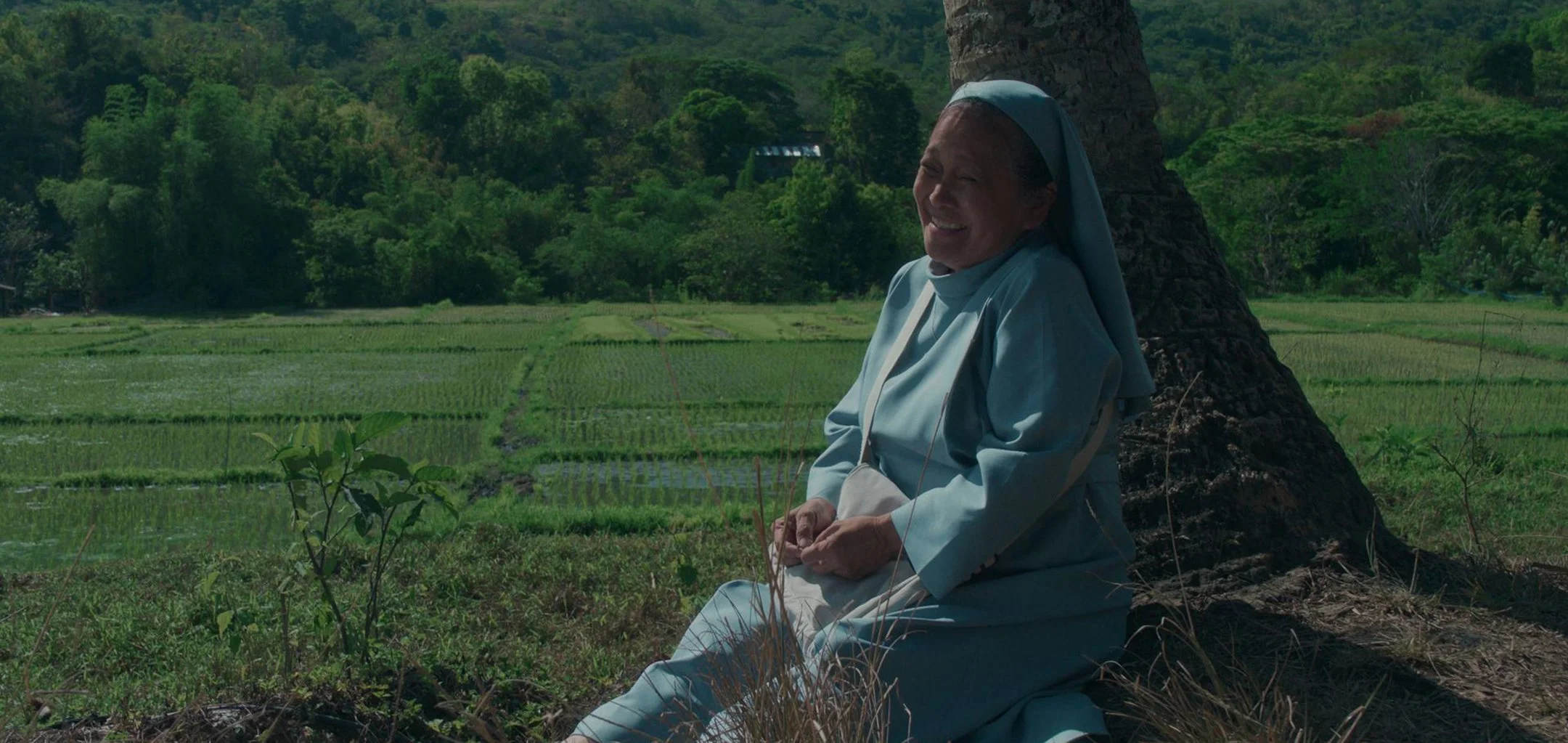
The story follows a Fillipina nun, Sister Yolanda, deep in her dedication to the convent she has cloistered herself to. She is characteristically humble for a nun, but also cheeky in her humour and certain of her independence. In other words, completely lovable. A long first act of the film labours this characterisation; but it’s worth it. Ruby Ruiz’s performance is rich and complex without feeling imitational. Her star quality is meteoric.
Any surface-level niceties that the film draws out in the beginning are slashed when Yolanda witnesses the suspicious death of a construction worker. When some start to suspect members of her parish, Yolanda subsequently questions the religion she has dedicated her life to.
At this point, it would have been easy to gas up the drama and turn the film into a hop-and-jump whodunnit à la the Knives Out Trilogy (there really is a God when a film avoids Daniel Craig’s Mississippi accent). Instead the pacing is true to the film’s meditative and mature purpose. It relies on authenticity rather than campy genre conventions to leave the audience in suspense, and this is what makes Yolanda’s doubts believable. Religious contemplation is rarely taken seriously when it’s rushed.
There is a scene which perfectly captures the elegance of this pacing. Along the bank of a silken river, Yolanda and Sister Arlene walk at the speed of a cloud on Valium as they confide in one another. They take one baby step at a time and it lulls the entire atmosphere. Every detail in the scene then becomes apparent—the colour of the nuns’ soft, baby-blue habits; the way it matches the rippled blues of the river; the hushed quality of their voices. It’s stunning; but more importantly, it sets the perfect conditions for deep contemplation.
All this may read as that one disputable word—a word which has been used by arthouse cinephiles and Marvel fans alike to assert a kind of authority on time—‘slow’. But First Light is not a slow film. Sure, when comparing it to the popular jock of the moment, One Battle After Another (2025), the speed of events is vastly different; but in terms of how much story each movie offers, they’re relatively equal. PTA loves to make films which have a restless energy—a throng of anxiety keeps you on the edge of your seat as you knock back a Coca Cola without thinking much more than the words oh BOY. But Robinson doesn’t insert high frequencies in his film. Even when everything is out of control—when Yolanda commits moral transgressions and near body-horror levels of injury are all happening at once—there is a sense of trust in the ending that is bound to arrive. If you were as flat on the nose as I am, you might call this ‘narrative kismet’.
There is an element to all this high praise which belies how impressive it is for a first time filmmaker. And yet, though it may be taboo to reference a director's past, I want to say: ‘it looks legitimate because he’s a photographer’. It doesn’t look like someone’s first film, and Amy Dellar’s photographic vision can’t be discredited in achieving this. If you take just one shot from the entire film, the composition will tell a story all by itself.
Robinson has always been a master of light, controlling it to reach territories of glamour, camaraderie, and romance. His subjects are lit by a high-key spotlight, beaming through the darkness surrounding them. It’s a poetic style, and poetic because light is a major part of how religions have communicated the majesty of spiritual experience. Take Catholicism’s particular zest for it: “in the beginning there was light”, votive candles, Heaven’s glow, the way Jesus insists on calling himself ‘the light’. The word itself, enlightenment, has inseparable religious connotations. First Light seems aware of the irony in this word’s usage, given that, sure, one can be enlightened about God’s existence, but they can also be enlightened on institutional corruption which serves the bourgeois elite.
There’s a lot of room to debate what the film’s title is a reference to. A less complicated guess would be that it refers to the film’s extraterrestrial opening shot of nuns lighting candles in cavernous darkness. In any case, the first light of the day purely means that there will be a day; and this automatically summons a sad feeling of continuation—of hope.
At this point it should be said that Robinson is a Melburnian. His social and artistic impact has been felt in this city for some time. If you glean his film’s premature reviews on Letterboxd, you’ll find some proud declarations made by his social and artistic acquaintances. Melbourne loves cinema, and yet it struggles to make films of the high standard it adores. This film is an exemption; a total leap out of the water that shows filmmakers in this city that they, too, can make a movie of the same calibre. Mosquitoes (filmmakers) are maybe drawn to the electric blue light (thematic fixation) and its promise of emancipation because they’re unsure of what it really is at its core. To really know would be to fly too close to it and die. In this sense, Robinson hasn’t given his audience a complete understanding of his artistic obsessions just yet. Instead he’s shown other mosquitoes how to fly close enough to get a glimpse of their own.
Follow Jake on Letterboxd.
First Light screened as part of ACMI’s MIFF Encore Program during October. For more info, click here.