
Film Review - Life After
Images courtesy of DocPlay.
(Content warning: this article contains mentions of suicidal ideation)
Life After (2025) lifts heavy in its turbulent journey through moral dilemmas. Life, suffering, and death are central to this journey through stories of suicidal ideation. Director Reid Davenport spotlights the societal abjection of disabled bodies, and in doing so, reveals the cached priorities of bureaucratic and capitalistic forces. It leaves a bitter taste, and yet the audience is gifted with a sweetness. The final shot sees Davenport approach a blooming flower. He holds out his hand, touches it, and I scrawl in my notebook —’to touch a flower (to live)’. Davenport’s intent crystallises at this moment. Beauty remains something within reach and the film—despite its katabasis—becomes an advocate for reaching.
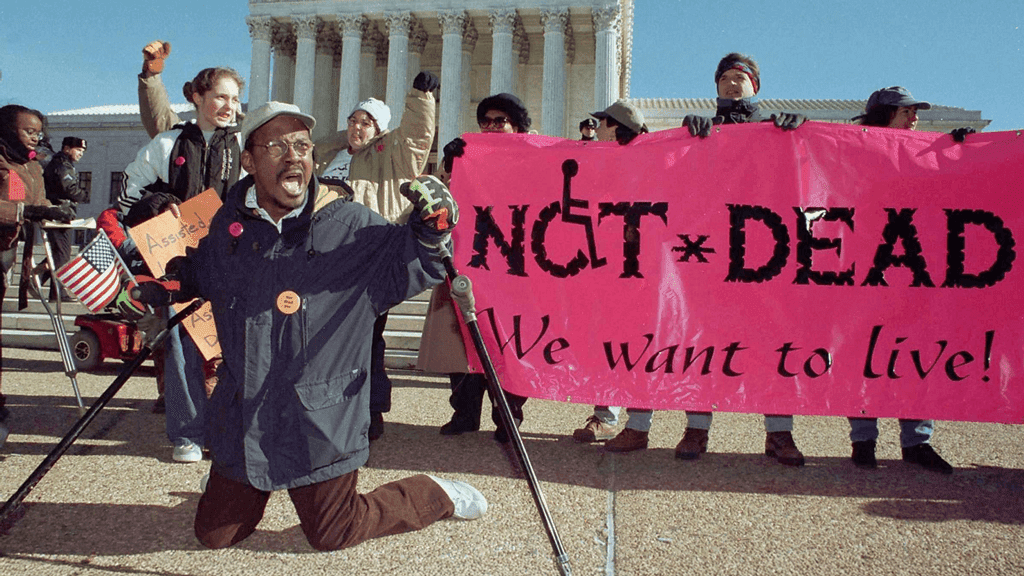
The film follows a legal case initiated by Elizabeth Bouvia—a California woman with cerebral palsy and severe arthritis. In 1983, journalists swarmed the courtroom’s doors as Bouvia appealed for her right to die. She proclaimed that her chronic suffering—her quality of life—was a burden; not just to herself but to others.
Davenport wants to track down Bouvia. From a quick Google Image search of her name, he unearths a photo of an elderly woman in a wheelchair. The woman in this photo is smiling; a sunshine-crusted implication of a happy life. If this is her, thinks Davenport, then Bouvia’s fatalistic outlook must have radically changed; her depression must have lifted. This assumption prompts an interesting question: What is quality of life? And does life’s subjectivity mean it could change over time.
Through interviews with disabled individuals (and their loved ones), the film navigates stories of surrender. The prospect of voluntary death is painted with a palette of experiences; an unexpected loss of a primary carer; an insistence to pull the plug; a case of commonplace depression. These stories prompt a second investigation for Davenport—Canada’s Medical Assistance in Dying (MAiD) law. What’s alarming is just how easy it is to kill yourself in Canada.
Although euthanasia exists in Australia, its criteria is stringent. In Canada, however, there is an inconspicuous loophole. Any individual with a physical disability is eligible to access MAiD. This raises another question—if a maple leaf falls from a tree, and nobody hears it crunch under a boot, is Canada as progressive as we think it is?
From here on, the film exposes a labyrinth of eugenic interests. A montage of people promote able-bodied, blue-eyed whiteness in what resembles a television advertisement. They make discrimination a simple matter of education as they claim that most people would approve of eugenics (if they understood it better). It’s nauseating and worthier of interrogation than Sidney Sweeney’s ‘jeans/genes’ monologue. Meanwhile, Australia’s own philosopher, Peter Singer, hones in on his belief that disabled babies should be killed at birth. The absurd comment feels derivative of a biblical jealousy; after all, there are multiple stories of baby massacres in the bible.
These cutaway clips of eugenics fetishisation justify the film’s existence. They highlight the readiness of society to eliminate any trace of the unfamiliar. Davenport even says that “segregation is part of the drama of being disabled.” The political focus of his films prioritises two essential aspects of documentary filmmaking:
To present the gruesome and beautiful world we are growing into and to opacify the experiences of overlooked people.
Life After spotlights the crossfire of physical disability and mental illness. It makes a simple point—depression happens to anyone, but its more compelling case is that mental illness should not have fatal consequences. The film effectively creates intrigue in its narrative finesse and the end result is a medley of positive perspectives from its subjects. In other words, the ending is a metaphor of possibility. For the interviewees, there is a way through a depressive episode. Reaching—for a future, for a hug, for a flower—is portrayed in this film as a productive (and feasible) act.
It would be easy to depend on these stories alone to talk about hope, but the most charming shots of this film are the slice-of-life moments. Davenport attaches a camera to his motorised wheelchair—a revered technique from his Sundance-celebrated film I Didn’t See You There (2022). The perspective is both foreign and familiar. It’s an unconventional angle in cinema—shooting from waist-height—and yet, the smooth passage of the world going by is tranquilising. The effect feels much like being lulled to sleep in the backseat of a car. Davenport films the streets of Brooklyn, buildings in construction, and a wintered tree with a particular majesty. These moments share a focalised sense of calm. They replicate the speed of gratitude.
All this said, there are fallacies in Davenport’s storytelling. The biggest among them being his assumptions of Bouvia’s rationale and actual quality of life. He questions her desire to end her life by splicing pauses in her dialogue from archival footage. In this way, she’s made to seem unsure of her own beliefs and philosophies; a thoroughly produced effect that serves the overall agenda of the film. The downside, however, is that it presumes her suffering was not equal in gravitas to death.
These assumptions are more or less permissible as the film comes to an end. Bouvia’s sister reads aloud from a short retrospective essay that Bouvia wrote in her final stages of life. It’s a moving moment which carries a complicated feeling—contentedness and regret for proclaiming her desire to die. Perhaps it was the flurry of the media? Perhaps the attention was addictive? And confusing? The complication as a viewer is in deciphering what kind of source this essay is. Primary—in the sense that it was written by Bouvia herself; or secondary—given that it is her sister (and Davenport) who contextualises her words. Either way, it would be more credible if the audience was left to be unsure.
The visceral experience of seeing this film at the cinema was equally filled with questions. Halfway through Life After, intermittent tuts of outrage started coming from the audience. At times, it was unclear as to what these tuts were for. Could it be that they shared Davenport’s indignation? Or that they’d been challenged on their air-tight ideas of voluntary assisted dying? It turned out an elderly man had fallen asleep and his snoring was disruptive. His ability to catnap puzzled me because this film is truly engaging. Its questions about truthmaking and subjective experience are incisive and wobbly, and accessible for any audience. Nonetheless, I tip my hat to the man who fell asleep at ACMI. He, at least, bypasses suffering through his dreams.
Follow Jake on Letterboxd.
Life After is screening exclusively on DocPlay from November 3. For more info, click here.