
Images courtesy of HSCB Spanish and Latin American Film Festival Australia.
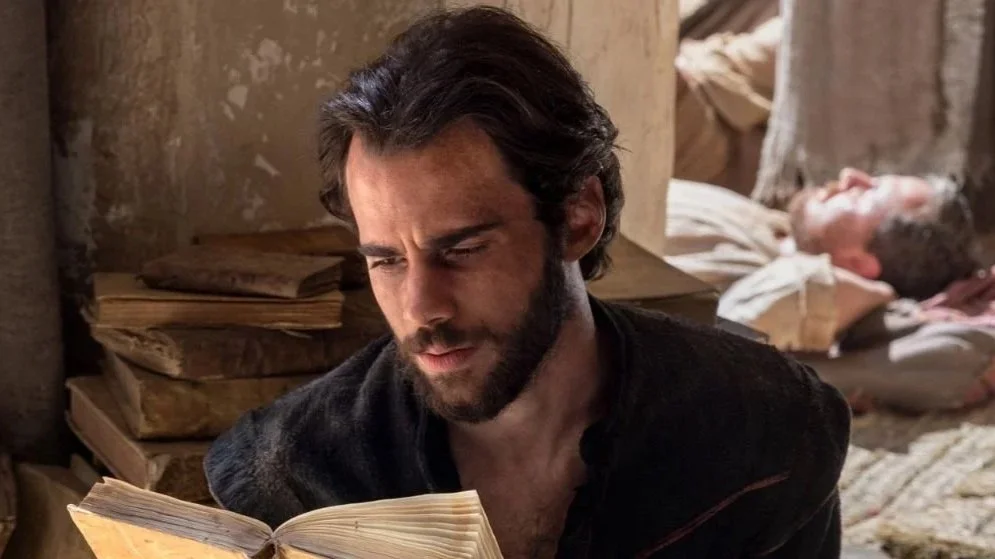
Alejandro Amenábar’s period drama The Captive is a slick, sexy, low-key adventure that blossoms with life from the contained walls of an Algerian prison. Beginning in 1575, The Captive dramatises a five-year period in the life of famed Don Quixote writer Miguel de Cervantes, then a Spanish Christian who was captured at sea by Barbary pirates and held for ransom in the Regency of Algiers.
The film opens with a harrowing slave auction which Cervantes escapes by claiming he is an important individual; this ironically lands Cervantes in prison with an impossibly high ransom. He and the other Christian captives brave torture and execution at the hands of their Muslim captors, but Cervantes’ uses his skills as a storyteller to spread positivity among the captives, which earns him the interest of Algiers’ governor.
Cervantes has been little depicted in cinema, despite his legendary status in literature. Amenábar’s passion for Cervantes oozes off the screen; he is able to weave a highly entertaining narrative from what little is known about this period of Cervantes’ life, using the adventurous, romantic and humorous spirit of his writings to inform his depiction.
The Captive manages to do a lot with its modest budget, delivering an impressive visual feast for a Netflix-produced period piece. Quality makeup, costuming and production design give a tactile, lived-in feel to the locations and sets which are smartly shot enough to hide any gaps in the budget, even when characters venture out into the sprawling city.
One fascinating aspect of the film is the depiction of a homoerotic relationship between Cervantes and Hassan Pasha, a Venetian-born Muslim convert and the governor or ‘Bey’ of Algiers. Though historically unsubstantiated, this relationship has been the subject of rumour for centuries – a fellow captive officially accused Cervantes of “unsavoury acts” – Pasha was a documented homosexual, and he displayed an unusual leniency toward Cervantes’ multiple escape attempts.
As is to be expected, the film has received backlash for this depiction of Spain’s national literary hero. Amenábar, himself gay, has stated there was no personal reason for centering this aspect of the narrative and simply found these rumours to be the most interesting proposition dramatically. The romance does not detract from the film, instead upping the stakes and giving them a sexy “enemies-to-lovers” edge. An argument could even be made that Cervantes’ sexuality is depicted ambiguously, and he perhaps leverages the Bey’s interest in him for leniency and protection. The same can be said for Cervantes’ Christianity: at one point, the Bey tells him, “you are just as faithless as me.” While some captives cling to Christianity for solace, others, like the Bey himself, have converted to Islam to escape their imprisonment and relish in the “sinful” delights of the Regency of Algiers.
The film’s tonal inconsistency is perhaps its biggest misstep. Early on, the prison is a place of constant threat and torment, and brief moments of humour are welcome. As it progresses, however, these harsher realities of captivity mostly vanish, and the captives spend much of their time leisurely conversing about Cervantes’ time outside the walls. This softens the stakes somewhat and makes escape attempts feel less urgent, but by this late stage the drama has grown complex enough that the shift is not overall damaging.
The Captive may not do enough to earn classic status, but Amenábar does deliver a highly entertaining, contained adventure with solid pacing, compelling characters, and an engaging plot. Some may have a problem with its liberal recounting of history, but if met on its own terms, it is sure to captivate.
Follow Harvey on Letterboxd and Instagram.
The Captive is screening as part of the 2026 Spanish Film Festival, which runs from the 12th of June to the 5th of July. Check out the festival website for more info here.