Europa Europa Film Fest 2026 - Made in EU
Images courtesy of Common State.
Stephan Komandarev’s Made in EU (2025) shows the stark reality of a not-too-distant past. Set in a rural, factory town in Bulgaria in early 2020, the film depicts a small community and its large, overcrowded Italian-owned textile factory amid a public scandal and looming crisis we are all very familiar with. The ‘scandal’ being its first recorded Covid case.
The story follows protagonist Iva, a widowed, middle-aged factory worker, played by Gergana Pletynova. At a doctor’s appointment while clearly feverish, she is denied approval for sick leave. We know it’s not a one-off as the exasperated worker asks, “Do we have to drop dead before we can get sick leave?” At this point, Bulgaria has just entered a state of emergency due to Covid-19. We hear this over the radio on the full bus taking Iva and her colleagues to work, no masks in sight. With all this context and seeing Iva’s flu-like symptoms, you can tell immediately where the plot is going, yet it only deepens the suspense.
We see Iva get through her long work days in the factory managed by a stern, almost militaristic foreman. We hear factory workers gossiping about the workplace being reported for health violations, and the reporting staff member being fired because of it. The foreman confirms it in his announcements - serving it as a warning to the staff. He also announces additional unpaid overtime, and throws in the contradictory line, “We treat you like human beings here”.
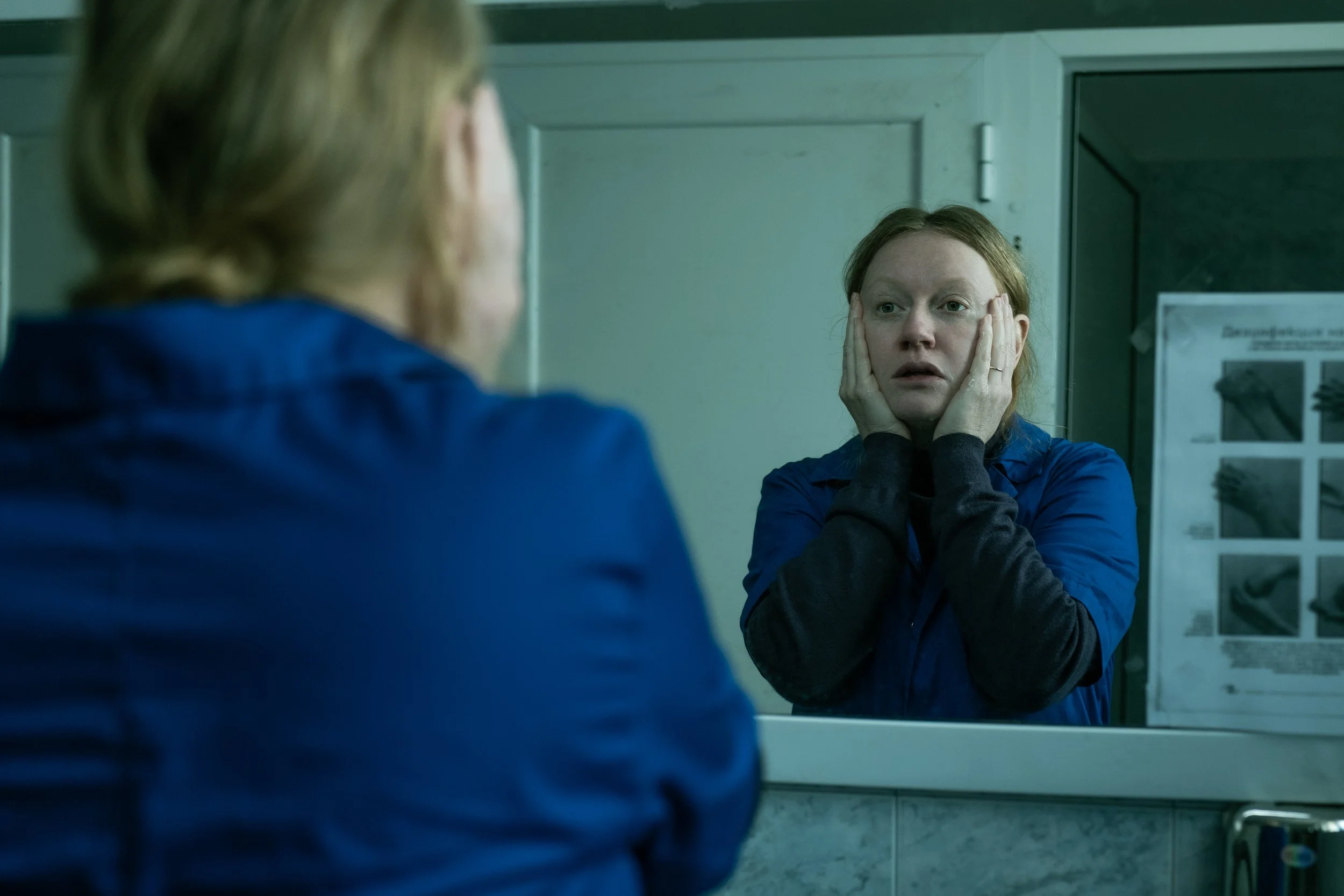
Like their dimly-lit workrooms and blue uniforms, the lighting throughout the film is muted and cool-toned, the palette also dominated by blue. Temperature checks on entry are already implemented in the factory as a Covid prevention measure, and we see Iva’s concern as she approaches the thermometer.
Gergana Pletynova’s performance is captivating as the stoic lead who bears the brunt of the fear, hostility and emotional turmoil that eventually consumes the town. Despite showing very little expression, through her gaze you can see her internalise what happens in real time.
In spite of the factory’s unrelenting work conditions, it is described by other characters as ‘a gift from God’ for the small town, as it is its main industry. Even Iva tries to encourage her young, university-educated son who makes YouTube videos to work there with her. He, however, plans to move to Germany with his girlfriend. Through Iva’s only son, the film tackles the theme of brain drain in Bulgaria. His youth and idealism shine through his vocal disapproval of the work conditions in the factory when he tells his mother “you will die bent over a sewing machine”.
A lot of these conversations in and out of the factory are shown from a distance. Some are from across the work floor or from the corner of a room, so the view is almost like that of a security camera. Other times it is much closer; at eye-level of a fellow factory worker or via someone’s vertical camera on their mobile phone. When Iva is whispering discreetly to her friend/coworker whom she works directly across from, the camera seems to be in between other nearby workers, and when the staff are singing happy birthday with a cake to a fellow coworker, some of the shots are from a vertical mobile phone camera.The film is loaded with these hidden POV shots from various angles. During dialogue and action, it really feels like you are peering into Iva, her son and the townsfolk’s lives.
From the voyeuristic cinematography to the lack of a musical score, this film is hyperrealism at its best. It only enhances the thriller atmosphere after Iva tests positive for Covid. As the news spreads (pun intended), we see her interactions with her friends and coworkers change, a major investigation into misconduct at the factory begins, and some concerning behaviour from townsfolk looking for someone to blame for the outbreak. While the theme may be close-to-home, the story is not all predictable and there are plot twists that satisfy.
Seeing Iva be ridiculed by her own community and become a subject of investigation through the voyeuristic camerawork, you can’t help but feel like a bystander. As powerless as the protagonist.
I think just enough time has passed since the Covid-19 pandemic to appreciate this film which reflects some of the judgemental and harsh behaviours that may be familiar to many of us. But it doesn’t just stop there, it also sheds light on greater societal issues: injustices in the textiles industry, the exploitation of cheap labour in Eastern Europe, power imbalances in single-industry towns and the migration of young professionals. All through the lens of a very gripping thriller.
While the film offers plenty to be unpacked, its appeal is wide-reaching. At its core, Made in EU is a well-made realist thriller that many will be able to relate to.
Follow Maria on Instagram and Letterboxd.
Made in EU screened as part of the 2026 Europa Europa Film Festival, which runs from February 19th to March 19th, with select encores running till March 26th. For tickets and more info, click here.