
Images courtesy of Umbrella Entertainment.
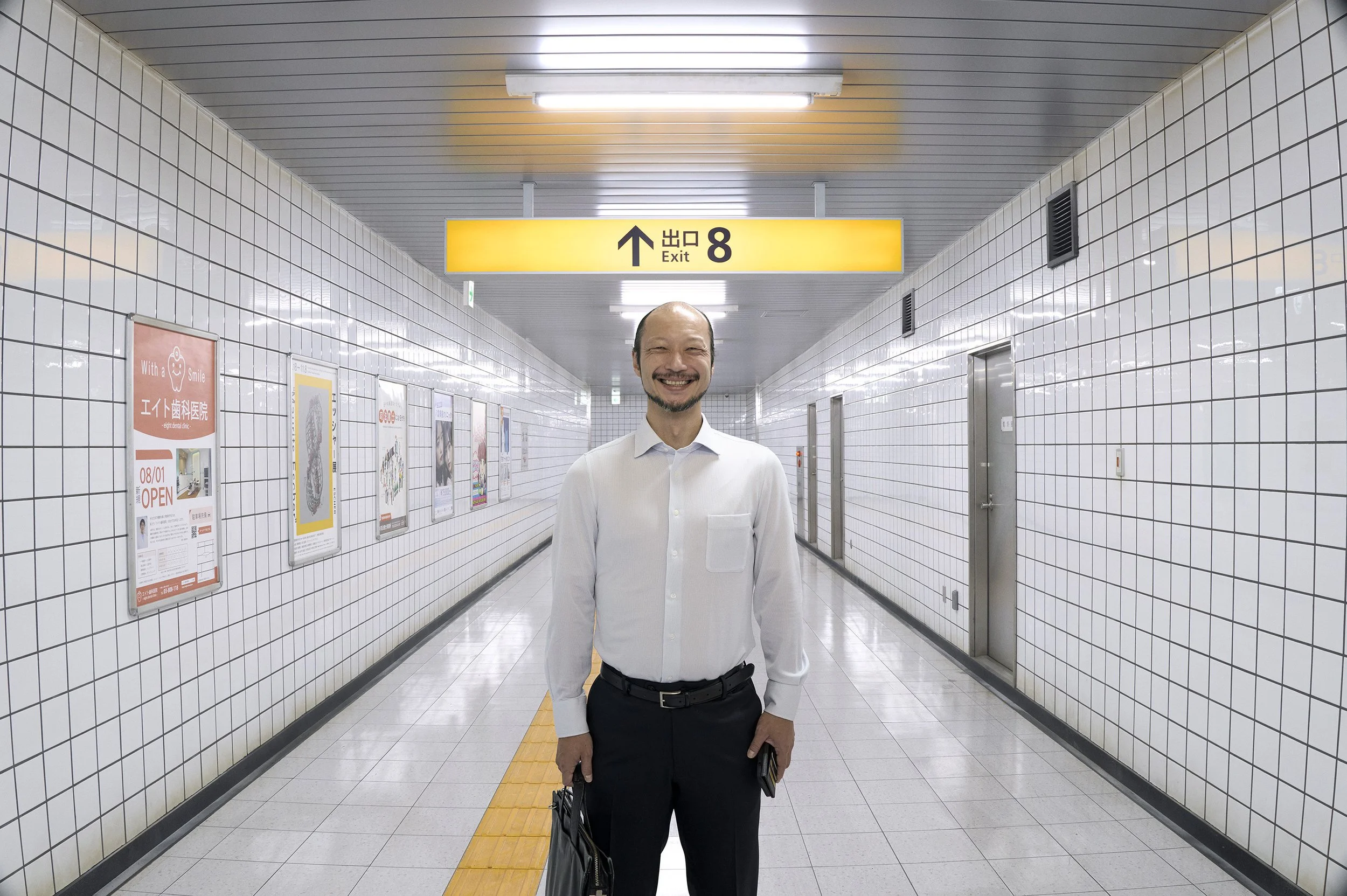
What’s immediately striking about Exit 8 is how unassuming it is, given the simple plot outline: a man is lost in a looping subway tunnel, and in order to progress, he must only proceed ahead if there are no anomalies. Genki Kawamura builds an entire film out of a single repeating corridor, and instead of feeling like a limitation, it becomes the film’s greatest asset. There’s a quiet confidence to the way the movie unfolds - nothing flashy, not desperate to impress, just steadily tightening its grip as the protagonist walks the same stretch of underground passage again and again. It’s a simple idea executed with enough precision and imagination to make it genuinely compelling.
The corridor itself does a lot of the heavy lifting. It’s clean and fluorescent, perfect for the liminal horror genre that the game it's based on occupies. Kawamura understands the power of the premise, giving the viewer just enough information that at a glance, all looks fine, but you’re left constantly guessing whether it was all in the right order. The film trusts the viewer to notice these shifts, and that trust makes the experience more engaging. You start scanning the frame the way the protagonist does, half‑expecting to suddenly pick up on something he hasn't.
Despite the gripes I have with this as a fairly common trope of the genre, the subplot about impending fatherhood manages to give the film a bit more emotional weight, as it’s handled with more restraint than most horror films that try to weave in personal anxieties. Instead of pausing the story to deliver a monologue about responsibility or fear, the film itself has so little story (considering the game can be beaten in about 10 minutes), that it's easily incorporated throughout and in between the scares. The corridor becomes a kind of pressure chamber for the protagonist’s internal panic, and by the time the connection becomes explicit, it feels like a natural extension of what we’ve been watching rather than a thematic detour.
The repetition - the film’s core mechanic - is used thoughtfully, for the most part. Each loop feels distinct enough to avoid the sense of watching the same scene on repeat, and the variations are introduced with a rhythm that keeps the tension simmering. The film never rushes to escalate, but it also doesn’t stall, even if a bit more editing here or there wouldn't have hurt the pacing. There are, however, a couple of choices that break the spell. There's a recurring sound effect, seemingly not from the game, which is used so frequently that it stops feeling atmospheric and starts feeling like a notification you forgot to turn off. Also, a scene involving some rat creatures lingers on some slightly undercooked VFX, and while the design of the creatures is conceptually interesting, they are shown in such crisp detail that they lose that sense of unease. The idea works; the execution doesn’t. It’s one of the few moments where the film’s minimalism would have served it better than the attempt at spectacle.
Even with those missteps, Exit 8 remains a smart, engaging piece of foreign horror filmmaking. It’s not trying to overwhelm you; it’s trying to draw you in, to make you pay attention, to let the unease build slowly with the rhythm. Kawamura’s direction is assured, the performances are grounded, and the film’s commitment to its looping structure gives it a distinct identity. It’s the kind of film that lingers not because it’s loud, but because it’s quietly, persistently unsettling.
Follow Eli on Letterboxd, Twitter/X and Instagram.
Exit 8 is screening in cinemas from Thursday the 23rd of April. For tickets and more info, click here.