
Film Review - Nuremberg
Images courtesy of Madman Films.
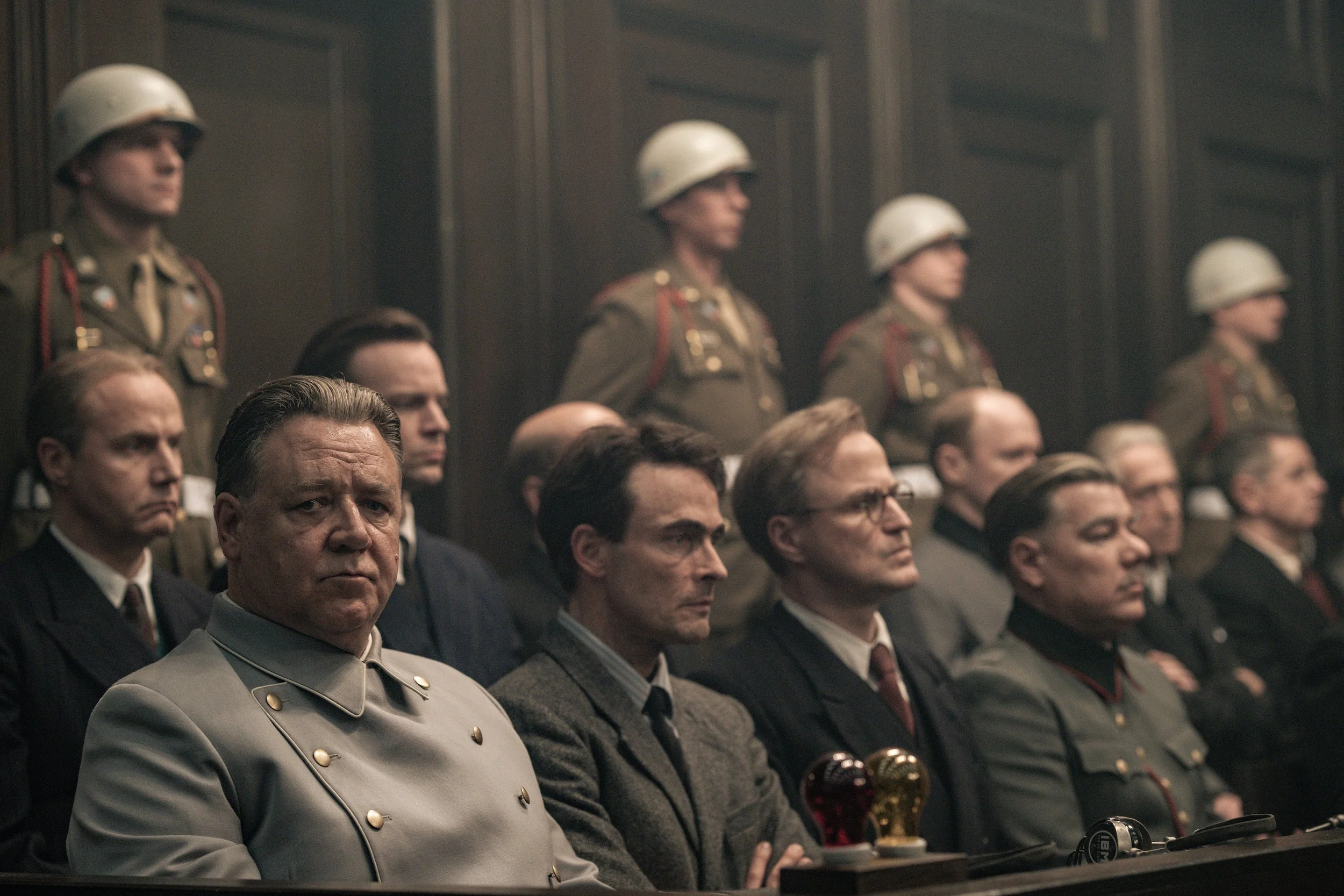
Nuremberg, directed by James Vanderbilt (Truth), is an interesting though at times confused film. It often struggles to balance the gravity of its subject matter with moments of lighthearted, quippy dialogue exchanged between Nazi officials. As the title suggests, Nuremberg is set in the immediate aftermath of WWII and follows the urgent question of what to do with the surviving members of the German high command responsible for crimes against humanity — most notably the persecution and murder of millions of Jews in concentration camps. Hermann Göring, played by Russell Crowe, is the most prominent of these figures as he is Hitler’s second in command and oversaw the laws and concentration camps that targeted Jews in Europe. Rami Malek portrays Douglas Kelley, the psychiatrist assigned to monitor the mental state of the defendants as they prepare for and undergo trial.
The film raises several compelling ideas for viewers to consider, including the difficulties of establishing international law and the founding of the United Nations to uphold it. It also explores Göring’s claim that, by the standards set for the trial, many Allied leaders could likewise be accused of war crimes, even stating that he stands trial only because he lost the war. In a similar vein, Kelley suggests that what happened in Germany could easily happen elsewhere, including in America where people do whatever is necessary to gain power and influence. These provocations do linger in the audience’s mind, especially in the context of modern world events, reminding us how fragile the post-WWII order can be. As Dag Hammarskjöld, the second Secretary-General of the United Nations, famously remarked: “The United Nations was not created in order to bring us to heaven, but in order to save us from hell.”
Where Nuremberg falters is largely in the interactions between the characters and how that relates back to the story of Nuremberg. Malek and Crowe share strong on-screen chemistry, but Malek’s performance sometimes drifts into overly quippy territory, undercutting the seriousness of the storyline that is supposed to be taking place in Europe right after WWII. This tonal imbalance becomes especially jarring once the trial begins and real footage of the Holocaust is shown. The film also devotes surprisingly little time to the courtroom proceedings themselves. This is disappointing, especially given how much time is spent highlighting Göring’s intelligence, self-awareness of the situation he is in, and his confidence that he will be found innocent. As a result, the film’s climax when he is ultimately outmanoeuvered lands with less impact than it should.
A good historical film doesn’t need to be perfectly accurate, but it does need to portray its era with enough authenticity to spark fascination and encourage viewers to learn more. Nuremberg largely succeeds in this respect, though I wish it had approached one of the most consequential events of the 20th century with a greater sense of maturity in certain moments.
Follow Tyler on Instagram and Letterboxd.
Nuremberg is screening in cinemas from Thursday the 4th of December. For tickets and more info, click here.