
Images courtesy of Cinema Nova.
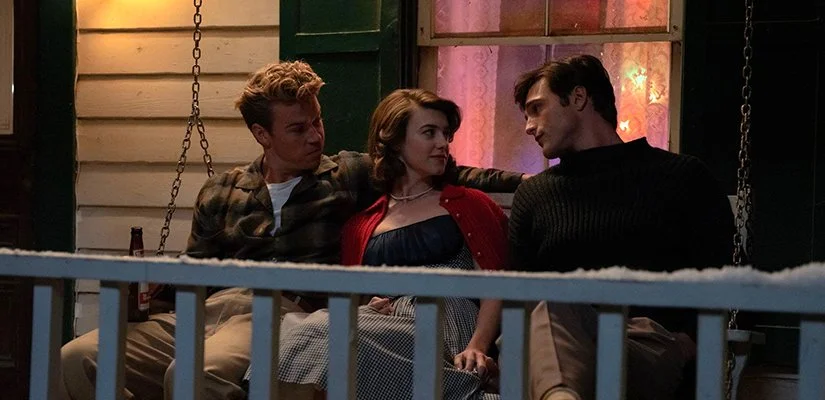
On Swift Horses explores the intersecting relationships of its principal characters but proves too ambitious, stringing together more narrative threads than its two-hour run time can support. Backgrounded by 1950’s America, and its involvement in the Korean war, the storyline follows newlyweds Lee (Will Poulter) and Muriel (Daisy Edgar-Jones), whose philosophies are challenged when Lee’s brother Julius (Jacob Elordi) is re-introduced to their lives. Julius and Muriel find a mutual interest in poker and eventually indulge in regular gambling routines in distinctly different environments. Though Lee remains a constant character in the film, it is Julius and Muriel whose lives in economy, occupation and relationships lead the film and offer the audience a juxtaposition in contemporary life.
Although the film is helmed by a stellar cast with impressive credits attached to their names, director Daniel Minahan’s debut feature film demands little of each role, doing little to flaunt the ensemble’s skillset. The characters do not seem to exist beyond the tropes they satisfy; Muriel the lonely, complacent housewife; Lee the arrogant, absent husband; Julius the lonely individual. These three, along with their love interests Sandra (Sasha Halle) and Henry (Diego Calva), evidence poorly explored motives which are poorly carried out or outright abandoned mid movie. The hollow writing results in an emotionally stale tone, leaving the audience grasping straws and questioning everyone’s motives, attitudes and actions.
Despite the narrative’s focus on relationships, the primary character interactions feel one dimensional and are not developed enough to sustain the stakes required to establish a strong sense of plot. Muriel and her love interest Sandra are spared from this idea in a singular scene which sees them romantically entangled without the leering eyes of other characters. The interactions achieves a tender, authentic moment but is too short lived to hold any emotional weight.
Adapted from Shannon Pufhal’s novel of the same name, On Swift Horses carries a storyline too long and too complex for its medium, resulting in a dense narrative. Many scenes largely felt unnecessary, inconsequential and produced an uneven pacing, failing to sustain the audience’s attention. Minahan spreads his work too thin, attempting to encapsulate a cacophony of individualised themes and relationships but failing to successfully carry out any notable ideas.
The lack of solid exploration between different scenes and ideas does not support On Swift Horses’ central comparison between Muriel and Julius. The film’s premise hinges on the similarities of the pair’s individual queer relationships and the consequences arising from contemporary prejudices. The dual storylines are approached dissimilarly and, as a result, do not manage to evidence their parallels. Although the thread of gambling is consistent, Muriel’s betting on horse races and Julius’ employment by a casino occur at opposing points in the film, failing to establish common ground and the central comparison between gambling and contemporary queer romance.
The novel’s reception (securing Lambda Literary Award Finalist spot in 2020 and being named a New York Times Book Review Editors' Choice) is evenly paced and manages to detail its intertwining plot. The film, however, poorly adapts its plot lines and fails to carry out Pufhal’s original intentions, instead resulting in an inconsequential narrative.
On Swift Horses is screening exclusively at Cinema Nova now. For tickets and more info, click here.