
Film Review - Ella Mccay
Images courtesy of 20th Century Studios.
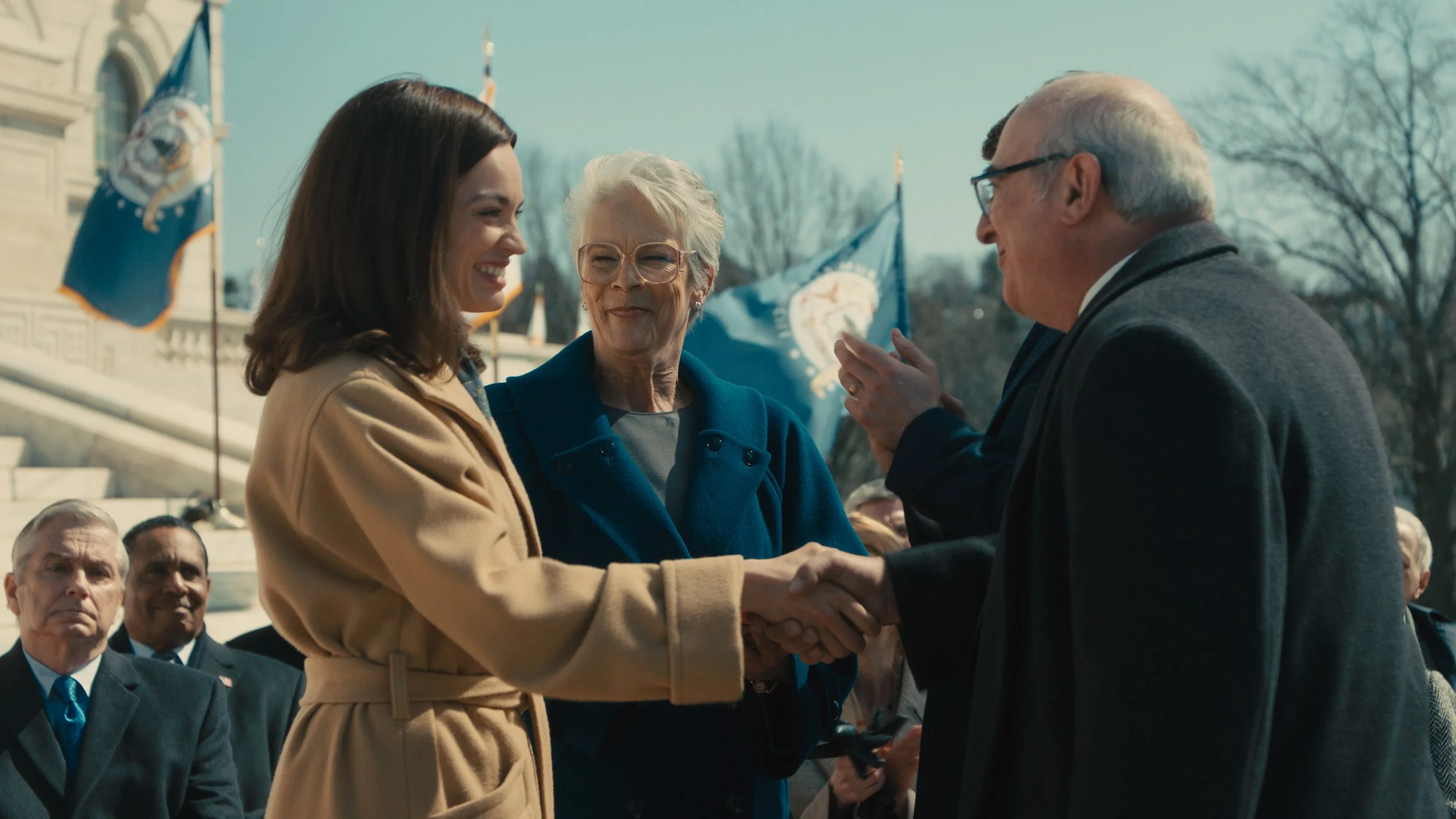
My only prior exposure to James L. Brooks’ long-form work beyond his 36 year ongoing stint as co-creator of The Simpsons (and his co-producer credit on Say Anything…) is one of my favourite RomCom dramas of all time, Broadcast News (1987), so I went into Ella McCay–and this review–comparing the two, as they follow very similar threads. Ella McCay follows the title character (Emma Mackey), an idealistic, career-minded and deeply independently-driven 34 year old, who deals with the societal pressure of assuming the role of state governor after the previous governor (and her mentor) is promoted to the Obama cabinet during the 2008 financial crisis.
Emma Mackey as Ella McCay is superficially remarkably similar to Holly Hunter’s character in Broadcast News, a fiercely idealistic career-oriented woman who, above all else, defends the power of social justice and the integrity of truth, and both find themselves in immense mental strife in reconciling their unconventional lives with their loved and unloved ones. However, it must be said that, compared to Hunter as Jane Craig, Ella herself barely functions as a thoroughly layered or interesting protagonist. Mackey is great and I’ll always bat for her (Sex Education came out at an incredibly formative time in my life), but it’s clear how much has been lost as the now-85 year old Democratic idealist Brooks has been hopelessly pushed toward the unproductive centre of the political spectrum as Republican fatigue and fifty billion seasons of The Simpsons weigh upon him. Broadcast News’ Jane Craig as a character is so vastly complicated in comparison, and wears her rich history of integrity, personal strife and career-drive on her face, whereas Mackey, through not much fault of her own, is endemic of how Lisa Simpson is written these days. Lisa has lost her edge and character flaws beyond her now-Fladerised self-righteousness, and though Mackey does her best I likewise wish the film wasn’t afraid to engage with the moral duplicity of someone in Ella’s position. At all times her aunt Henen (Jamie Lee Curtis) is infallible and wisdom-heavy and her deadbeat Dad (Woody Harrelson) is wheeled back into the narrative three times only to be predictably (but rightfully) told to get lost every time, which makes the film feel rather stagnant–more on that later.
It doesn’t help that Ella McCay can’t execute a character like Broadcast News’ Aaron Altman with finesse (although Albert Brooks is in Ella McCay). Ryan, Ella’s husband (Jack Lowden) is a sweet enough love interest who harbours deep insecure resentment at his disposition, much like Altman, but James L. Brooks has evidently forgotten how to pull this kind of character off without making him cartoonish. This is most evident in a scene in which Ryan conspires with his vindictive mother to selfishly gain further recognition for himself amidst Ella’s succession, a scene that is so unbelievably antiquated and emotionally heightened in a way that feels somewhat out-of-place to how tonally consistent the rest of the film is. That being said, Ella McCay wears this cartoonish dramaticism on its sleeve throughout, something I can undoubtedly see a lot of people disliking about it. The film is quite artificially soapy in a way I’ve only seen in similar late auteur projects like Almodóvar’s The Room Next Door, with characters being highly vocal, opinionated and dramatic in a highly artificial delivery that is bolstered by the cinematography and editing, but unlike The Room Next Door, this falls flat more often than it succeeds.
This artificiality is significantly compounded by the setting. The 2008 recession is referenced all over the film; bank-foreclosed houses litter the streets, Ella’s maybe-agoraphobic brother (Spike Fearn) runs what appears to be either an online speculative stock trading or a sports betting consulting business, and Ella offhandedly mentions that she campaigned to keep marajuina illegal in her state. Fittingly or annoyingly depending on how you choose to look at it, the film is very behind-the-times, only interested in the shallow optimism of that era, especially in how McCay’s attempts at social reform are often rooted in unproductive Democratic Party-isms. I’m only so bothered by this because Broadcast News is substantially more radical in its takedown of media manipulation and the bastardisation of truth without ever sacrificing its genre conventions. Likewise, The Simpsons used to criticise Democrats more harshly. Comparatively, Ella McCay’s political messaging is unbelievably stagnant, but I can’t deny that this is ultimately not the point. Without spoiling much, it ends on a tacky and shallow yet achingly sincere note that is clearly intended to be inspirational which, like it or not, perfectly fits the film’s given verisimilitude. I figure I’m so burnt out by these centrist theatrical releases lately that I’m aching for something with a spine.
There's a lot of comments I want to make on Ella McCay that don’t fit into the structure of my review, so here goes: Lots to love in this if you’re a Simpsons fan! Julie Kavner, the voice of Marge Simpson, plays Ella’s secretary as well as the narrator, so you’ll be hearing a lot of the Marge voice! Gracie Films, founded by Brooks, is a producer on the film (as with Broadcast News), so their logo appears at the start, unchanged from how it appears at the end of every Simpsons episode. Tracey Ullman also has a cameo in the film. Ayo Edebiri fans, don’t get too excited, she’s only in one (optically bizarre!) scene. Don’t forget to do the #EllaMcCayChallenge if you see a poster or standee for this at whichever cinema you see it at!
Follow Malachy on Letterboxd and Instagram.
Ella Mccay is screening in cinemas from Thursday the 11th of December. For tickets and more info, click here.