
Film Review - Nouvelle Vague
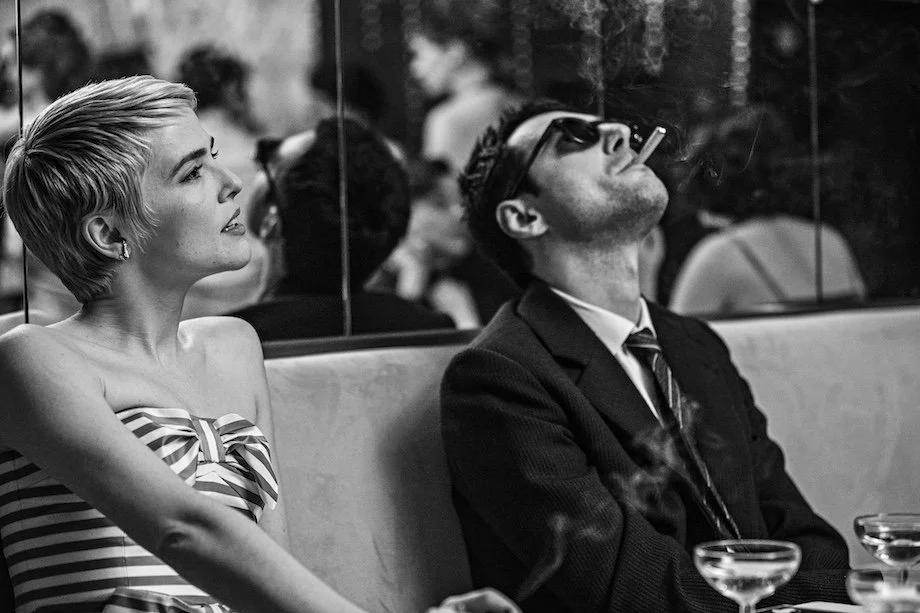
Images courtesy of Transmission Films.
Cut an apple in half and you will find seeds. Cut a francophile in half and you will find the French New Wave—or at least, a vocalised interest in it. The francophile vindicates their legitimacy by calling it by its original name, la Nouvelle Vague. This kind of pretension is common in certain circles, but in general we live in an era when middle-aged women are straying from francophilia (note: your aunty’s favourite dessert order, the crème brûlée, has been reduced to a Cadbury filling). France and its cultural references, cinematic or otherwise, are now seen as ostentatious and outmoded. They fall second to the exotic quietude of Japan. If love for France is ever to be restored, it will be because its perceived ostentatiousness is seen with fresh eyes.
Richard Linklater is a man from Texas. His films have given shape to American realism, American existentialism, and subcultures founded by the disenfranchised youth of, well, America. On the face of it, he seems the most unlikely person to direct a film about France’s most patriotically precious work, Breathless (1960). And yet the pairing makes astounding sense. Linklater’s breakout film Slacker (1990) birthed the eponymous genre and introduced his enduring fascination with characters who mistrust neoliberal realities. The slacker in this genre is a celebrated lazybones—a thinker with time in abundance. In cinematic history, what better example of such a figure exists than Jean-Luc Godard himself?
Plenty of films have been made about the shoe-gazing paparino (they even pulled out Louis Garrel’s hair to fit the bill), but none have cemented his mythological reputation like Linklater’s Nouvelle Vague (2025). The film narrativises the making of Breathless, rendering Jean Seberg, Jean-Paul Belmondo, Godard, and every other participant in the French New Wave, into characters. Guillaume Marbeck delivers the humour in Godard’s pretentiousness as if he’d stalked the man for decades; Aubry Dullin portrays Belmondo as a more likeable version of the actor’s real-life, philandering self; and Zoey Deutch fits the bill as an American discombobulated by French inertia to the point of tantrum. The cast are uncanny replications of their predecessors, carrying the weight of idolatry with gloved hands.
For a film that purports to be about an entire movement, a container is necessary. Godard is a fine one, considering he embodies the contradictions of the cinema he makes. His characterisation in Nouvelle Vague depicts him as a bratty conman, ironically making a film about deception. But (there is always a ‘but’ in New Wave cinema) art is as moral as law; as the character Jean-Luc says, “Artists and criminals are the same. They both want to surprise.” These regal one-liners centre him as the spectacle, more spectacular than the film he makes. More spectacular, still, by the carnage he causes with his explosive neurosis. He becomes as cringey and arrogant as a self-appointed Messiah—the kind you might find with a megaphone on some train station steps. It’s difficult to say whether Jean-Luc’s provocative tendencies are meant to be abject or funny; and yet, isn’t that just so… French.
The most interesting moment in the film is a whisper. Three women gather in a stairwell outside the iconic hotel room scene and speculate why Godard was adamant on shooting in Room 12 of the Hôtel de Suède. It’s because he has “personal associations”, they gossip, and this is where Linklater kicks open the metafictional door. Just like Godard replicating his own past, Nouvelle Vague is a time travel project which uses minutiae to replicate the era of 1960s Paris. Almost every location (Champs-Élysées, Boulevard Saint-Germain, the Cinéma Mac-Mahon), every prop (the hotel room radio, mirror, posters), costume (Seberg’s iconic striped dress), and even film stock is recreated to match the original Breathless. The result is ambiguous—it hits and it doesn’t.
The obsession over these details projects a deep nostalgia for an era of freedom and unrestrained creativity post WWII. Early in the film, Jean-Luc drives down a country road and speaks aloud to himself, much like Michel in Breathless. Later, Jean steps into a Parisian fountain and splashes around like another dominant blonde from La Dolce Vita (1960). Easter eggs like these are a bit of nerdy fun, but they also betray the spirit of iconoclasm which defined the New Wave, transmitting a sinister feeling of hyperreality disguised as nostalgia. In other words, the tragedy of this attempt to replicate a time when ideas were burgeoning, ideology was exciting, and American movie stars could thrust their careers into dangerous territory, is that it will always be impossible to know what it felt like. Given Linklater’s fixation with time in his earlier films, he likely wants his audience to recognise this fact. The shame is that he robs his own art of an awesome idea. He has a chance to say something on the creepiness of embalming and embodying cinematic ancestors, but instead gets stuck on duplications. A film which does this can only be a fetishisation, a palimpsest.
Still, Linklater is right to pine for this particular period. Modern day languor is fine enough; but, I’d assume it’s no fun compared to bricking a cop in May 68. Perhaps that’s the sixties, or perhaps that’s just France.
What is France in this film? The characters exist in a Haussmanian dreamscape, wearing intellectual suits and sexy capri pants. They strut, act, and argue along ever-present Parisian edges—a sidewalk, a banquette, an intimate moment—shaping us, the audience, into people-watchers en terrasse. The Frenchification is felt most of all through the wry and sardonic repartee of the script. More than once I snorted from laughter, and more than twice a man in Row A coughed up his popcorn. The intellectual humour and brazen confidence of the characters represent an essence of France, in part its national image, snooty and insouciant, and also how it actually is. It reeks of something cool. Could this be possible?
Not entirely. There are stylistic elements in Nouvelle Vague which are overdone. When a director, critic, or actor of the New Wave first appears, they stare, blank and wordless, into the camera as their name is stamped beneath them. It’s a call-back to the movement’s defiance against the rule that an actor should never stare into the camera’s lens. The effect is stilted in a way that suggests Wes Anderson barged his head through the door of a few production meetings. Fair enough that it would be tiresome to introduce each icon by name, but Linklater chose to make a film about a movement. His project was not exactly humble.
On top of this, the serif font of the subtitles is kitsch to the point of garish. Its design inserts a theme-park artificiality to the world Linklater is (re)building so that it bulldozes an impression that Breathless is as classic as Times New Roman. It’s a small detail, yes, but not when the subtitles have more air time than any of the lead actors.
Nouvelle Vague is Linklater’s answer to the credence that all directors must one day make a film about filmmaking. This is an absurd thing to believe. Art is not short on studies about its forms; comparatively, it’s completely lacking in its attempts to distill culture. Every film, when it depicts life as it is lived, dreams as they are dreamt, is a film about filmmaking. In this case, a director produced a serviceable story, attractive in style, loyal to a documented history. However, in his vain and painstaking attempt to create a perfect likeness, something was lost. If he had simplified everything to focus on the deeper truths of Godard’s godly ungodliness, I would have been cheery and France would have been saved.
The day after seeing Nouvelle Vague, I was stirred by something wrong. It was morning, and I had left the house to go for a walk. I passed by people in their finest office attire, but it was glary outside, so I applied sunglasses, as if to inspect the imposition of corporate life with due caution. Quelle surprise to discover that the world now resembled a vision of Paris. A cake shop flicked on its fluorescents; a dog licked coffee out of a drain; the sun tapped hard on Melbourne’s own Champs-Élysées—Smith Street.
In a shop window, I caught my reflection. Black sunglasses, unsmiling, I was the veritable ghost of Godard. It took an upwards glance to notice the big letters painted on Meatsmith’s window—‘HAM’. A deadly word with no French dignity. The cigarette smoke carrying through the air, which had previously smelled charismatic, was degraded to a bar fly’s breath. What I’d reduced to one thing turned out to be another. I was thrilled.
Follow Jake on Letterboxd.
Nouvelle Vague is screening in cinemas from Thursday the 8th of January. For tickets and more info, click here.