
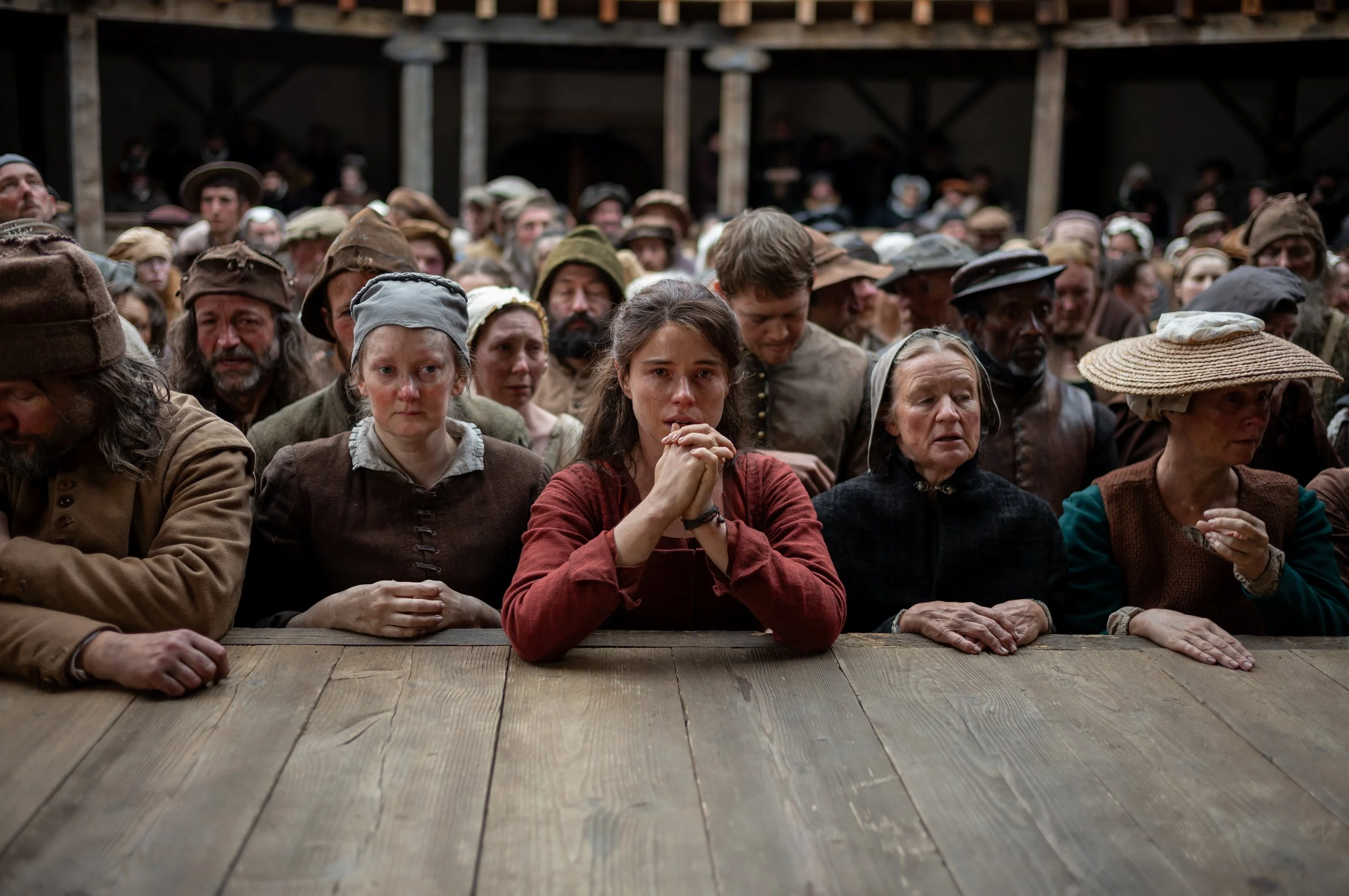
Images courtesy of Universal Pictures.
Twenty-seven years ago, the winner of the Academy Award for Best Picture was Shakespeare in Love, a reverential and referential romance that sought to draw out drama from the life of the English language’s most famous dramatist. Chances are, this awards season, Shakespeare will return to the Oscars. Not his works, but again, William Shakespeare the narrative figure – Chloe Zhao’s newest film Hamnet, arriving in Australian cinemas on January 15th, is tipped to compete for multiple categories at the Academy Awards. At its centre once again, of course, is Shakespeare himself.
Paul Mescal, after leading last year’s decidedly unimpactful Gladiator II, co-leads as The Bard, alongside the always-luminous Jessie Buckley as *not* Anne Hathaway but “Agnes”, the woman who marries him. At the centre of this story is their only son, Hamnet, the similarity of whose name to that play is no mistake: the film opens with a titlecard stating simply that in this era in Stratford-upon-Avon, the names Hamnet and Hamlet were interchangeable.
The film is adapted from a 2020 novel by Maggie O’Farrell, which imagines a version of Shakespeare and his wife’s lives before Hamlet first premiered on stage sometime in the early 17th century. The book, it could certainly be argued, is Agnes’ story, and it also received significant praise for its thoughtful depiction of life in late-1500s England. Under the dreamy, delicate direction of Chloe Zhao (who, it must be noted, has already brought home a Best Picture Oscar for 2020’s Nomadland), Agnes’ story becomes a meditative, moving heart-wrencher with a clear intent to maximise emotional impact – for better and for worse.
Most apparently, Hamnet is a showcase for some incredibly committed performances. Buckley, justifiably, is the one everyone is coming out gushing over: her Agnes is raw, headstrong, sensitive – a whirlwind of passion and ferity. The character’s facility with traditional remedies, taught by her mother, becomes analogous to her instinctive, unfiltered nature, which in Buckley’s hands is a conduit for powerful charisma. Mescal, while hardly breaking from his usual brooding, tortured screen persona, finds in Shakespeare (a pretty unenviable role to have to tackle) a recognisable humanity. The performance is a capable balance between believability as the man who produced such totemic work, and a functional cinematic lead who we can empathise with and relate to. This high-wire act falters when the screenplay finds Shakespeare writing a famous soliloquy in real-time: reciting the words aloud as he “writes” them is too great a demand on Mescal (or on anyone, really). Also of note, lastly, is the reliable Joe Alwyn as Agne’s level-headed, open-minded brother Bartholomew: Alwyn’s innate seriousness and intense-listener quality really bring out the best in this supportive-older-brother role.
Zhao herself brings much to the film. Her flirtations with the editing and visual stylings of Terrence Malick have always charmed me, and here the use of handsome little insert shots and quick montages of the natural world (leaves in the breeze, droplets on the surface of a lake) make the central love story feel mythical, magical. Unfortunately, too much of this ethereal visual style results in the first hour of the film getting a bit swamped in what I’ve heard smirkingly described as a bit of a ‘woo-woo’ quality: paired with Agnes’ characterisation, it’s all very tarot-card, Earth-Mother, kumbaya-forward – and Zhao has the proverbial dial cranked just a bit too far in this direction.
The film could also be accused of overdoing it when it comes to landing its emotional blows. The climax, while certainly affecting, feels almost pushy in the way it wrings this story for poignancy. I’m loathe to deride a storyteller from trying to earnestly evoke something in their audience, but Hamnet’s issue is one of calibration: particularly if the viewer knows anything about the story, the film taunts you with misleads and calm-before-the-storm teases before dropping the hammer, and it left me feeling stung rather than moved. The love story here does not need adornment: I smiled, spellbound, at Agnes telling her brother that William has “got more inside of him than any man I’ve ever met”. Instead, by the end of the film, I was rolling my eyes as one of 21st-century cinema’s most iconic and recognisable pieces of music begins to play, intended to lend weight to the big final moments and instead feeling uninspired and trite.
In fairness, the raw power of this story may affect people differently according to their life experience, and your mileage may (almost certainly) vary on the key themes of parenting and art-as-therapy. Yet ultimately, when you invoke the dramatic prowess of none other than Shakespeare himself, you invite an unsparing degree of scrutiny over the architecture of your storytelling. In that spirit, while much of this film’s richness of performance and visual aplomb is extremely impressive, it played to me as much clumsier on the emotional front. If Hamnet does indeed bring the Shakespeare-himself-as-drama film back into the Best Picture fold at this years’ Oscars, it will be a shame that honour wasn’t bestowed on a cleverer version of this film. Or better yet – another film altogether.
Hamnet is screening in cinemas from Thursday the 15th of January. For tickets and more info, click here.