
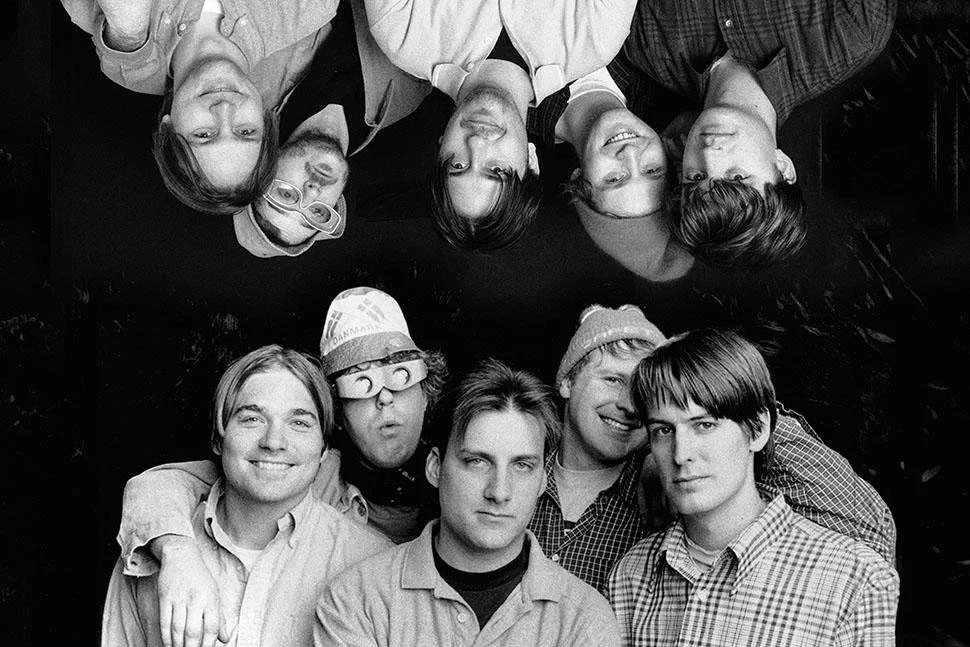
Images courtesy of Common State.
I’ll start off this review by emphasising that I am not a big fan of Pavement. I enjoy their songs and am generally familiar with the broad strokes of their career, yet a film designed to appeal specifically to the Pavement fandom shouldn’t have worked for me–so it’s really quite astonishing that this one does.
Alex Ross Perry is a friend and frequent guest star on the Black Check podcast (co-host Griffin Newman stars in Pavements), of which I am an avid listener, and aside from Pavements and his other new documentary Videoheaven, the only other film of his I’ve seen is Her Smell (2018). Due to his many lengthy ramblings on the podcast I’m very familiar with his very opinionated and academic approach to documentation, and where I feel this pins down Videoheaven to reductive and repetitive tendencies, I don’t feel this way at all about Pavements.
This is not Perry’s first foray into Pavement; he previously directed a new music video for Harness Your Hopes, a song Pavement recorded for 1998’s Brighten the Corners, but was dropped. The song was subsequently included as an extra on compilation CDs, and later inexplicably blew up on TikTok, becoming Pavement’s most-streamed song. The new MV, starring Sophie Thatcher as a pseudo-detective/fan being transported into their old music videos, is a meta-commentary on the rediscovery of Pavement by newfound fans. Perry’s approach to the video is pleasingly supportive of the band’s new fans and celebrates the unearthing of Pavement for the new generation as well as the old, so naturally, Pavements was perhaps always destined to evoke these similarly earnest threads, but I wasn’t expecting it to do so in such a brazenly experimental way. Forgoing the typical threads of the straightforward narratives of most musician biopics à la A Complete Unknown, Pavements goes for a mixed-media and approach similar to Rolling Thunder Revue or I’m Not There that fundamentally breaks the film up beyond typical biopic constraints, being made up of four segments that intercut constantly–and often play at the same time:
Footage from and the making-of a straight laced biopic titled Range Life: A Pavement Story, starring, among others, Joe Keery as Pavement’s lead singer/songwriter Stephen Malkumus and Jason Schwartzmann as Matador records producer Chris Lombardi. I was unable to find any record of this film, parody or otherwise, actually being produced in full beyond the snippets we see in Pavements. Perry has stated elsewhere that the low budget would not allow a straight-laced feature-length biopic about the band, so it is likely that we are seeing a sizzle-reel of sorts.
Footage from the opening of a travelling museum featuring Pavement-related artefacts that are both genuine and completely made-up.
Recordings of and the workshopping of a jukebox musical akin to Mamma Mia! titled Slanted! Enchanted! A Pavement Musical that uses Pavement’s discography as the musical numbers, which actually played off-Broadway over three days. The audition, blocking, rehearsal and performance stages are all shown. The musical tells the story of a musician who falls in love and moves to New York, where he questions the importance of fame in the music industry, and in a funny way unearths the notion of Malkumus’ often nonsense lyrics actually having a simple narrative of sorts once actually read aloud.
Footage shot by Perry following the actual band during their reunion tour in 2022 in conjunction with countless archival footage of the band from various sources and time periods, with a heavy focus on their 90s era.
The intriguing part about these ostensibly clashing strands is how wonderfully they coalesce. I feel a strict, four chapter structure akin to an anthology film would not have been as effective as the intercutting between the four. It means that Perry and editor Robert Greene can utilise the best parts of each segment to construct very deliberate narrative, emotional and tonal beats rather than feel limited by a linear trajectory, something that so often plagues lesser biopics. This structure, which creates a meta-narrative about Pavement and their hypothetical depictions in film, on stage, in museums and in documentaries, is key to how the film so effortlessly introduces viewers to the vibe of Pavement as a band. For instance, footage of the surprising dramatics of Slanted! Enchanted! being placed in the same film as footage of Pavement getting mud thrown at them during Lollapalooza ’95 create this multi-faceted yet spiritually-aligned image of the band. The film is, remarkably, very friendly to viewers unfamiliar with Pavement, and something that struck me so profoundly about the film was how effectively and quickly it cements their reputation and image, perhaps even beyond what they actually were. Yasi Salek of Bandsplain refers to Perry’s depiction of Pavement as ‘mythmaking’, and I can think of no better way to describe the levels of storytelling that feel akin to quickly cementing years of mythic lore as if Pavement were a folkloric figure.
Perry’s approach is, self-admittedly, inherently cynical and spiteful. He’s fully aware of the deliberate meta-commentary this is making on just about every level, even beyond the usual jabs at musician biopics, and my worry going in was that this mentality would be annoying. However Perry’s approach, perhaps because it’s so in-keeping with the stereotype of the Gen X/Millennial generation he and Pavement belong to, feels weirdly congruent with Pavement and Malkmus’ own image. Pavement, in that 90s Californian way, claim to not care whatsoever about fame or what people will think of their music, both from the point-of-view of supposed experimental artists or as pop-rock artists. Perry’s commentary on this persona, in a formal sense, is fittingly highly constructed, just as Pavement’s laid-back persona itself partially is, which I don’t mean whatsoever as a criticism. Joe Keery’s stubborn desire to learn Malkmus’ Californian accent to the point that he can’t get rid of it post-shoot (an amusing jab at Austin Butler’s work on Elvis) is indicative both of how much Pavements implicitly refers to this laid-back nature being as much an artificial showman persona as it is a genuine one, and also how integral it is to Joe Keery’s image as a serious actor of Malkmus to uphold the laid-back mythos.
Like most of my demographic (suburban, middle-class, white) I was always susceptible to the Pavement bug but Pavements has made me love them more than ever. Before I recommend this to anyone I would firstly strongly recommend at least listening to some of Pavement’s discography, not just because you’ll get a better sense of the band and film’s momentum, but also because it’s good music. Beyond that, the film is very approachable and digestible to new viewers, if you are willing to jive with its unconventional narrative structure, which I feel is a must if you enjoy the best musician biopics and documentaries. Like any good documentary or biopic, Pavements is perhaps as interesting as its subject, which is to say they’re both easy-listening encapsulations of a mentality to artistry that I hope never goes away.
One other note: Pavements is one of many films playing at the Melbourne International Film Festival this year that are distributed by Mubi in the US (though not in Australia), and I’d like to direct readers of this review to the fact that dozens of Mubi-linked filmmakers have signed a petition urging Mubi to cut ties with Sequoia Capital due to their ties with Israel. While I am not casting judgement on those viewing these films nor even the filmmakers absent from the petition, I urge you to keep this in mind when participating at the festival or purchasing Mubi products.
Follow Malachy on Letterboxd and Instagram.
Pavements screened as part of the 2025 Melbourne International Film Festival. For more info, click here.