
MIFF 2025 Film Review - The Chronology of Water
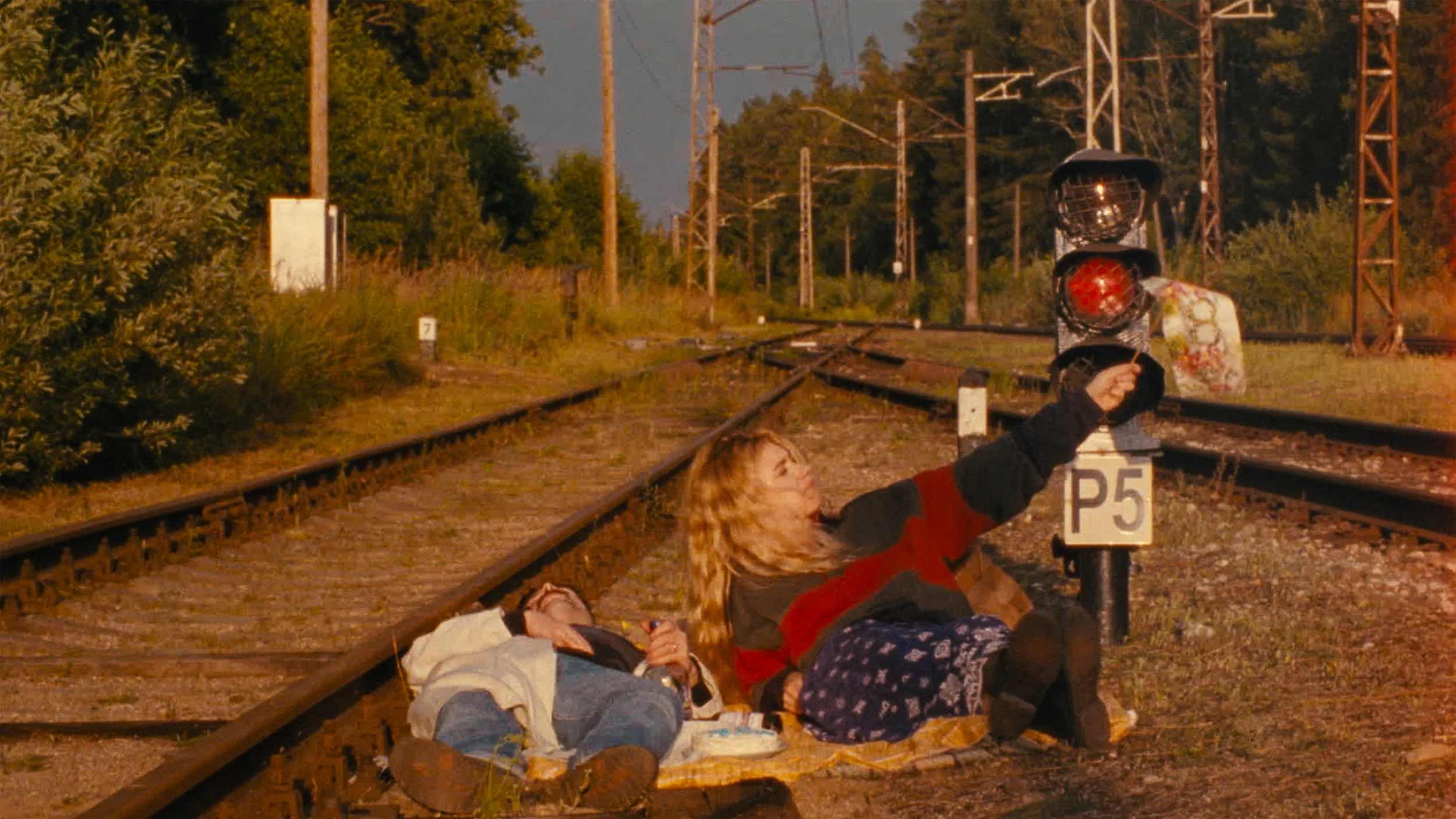
Images courtesy of Common State.
Few films can wrench your heart up into your throat and keep it there for a 128-minute run-time. This is one of them. Awash with devastating candour, The Chronology of Water (2025) marks a bold and fully realised directorial debut from Kristine Stewart.
Based on the 2011 memoir of swimmer Lidia Yovanovitch (Imogen Poots), the film is a medley of non-linear moments from her life. At its core is the child sexual abuse Yovanovitch suffered at the hands of her father and the subsequent trauma she was left to shoulder. Despite the gravity of its subject matter, there are moments of levity in the forms of Ken Kesey (Jim Belushi), Lidia’s writing mentor, and her own writing she comes to find solace in.
It is not unusual for actors to play musical chairs and end up in the director’s seat. These days, it’s more common than not, with Stewart joining the likes of Greta Gerwig, Bradley Cooper, and Clint Eastwood. Yet, it’s rather remarkable just how instantaneously Stewart asserts a fully-fledged and thoroughly distinct style of filmmaking. The Chronology of Water delivers its most crushing moments in the quietest of ways: in still shots of the corner of a room, curtained windows, and quick glances. Stewart leaves the audience to develop their own comprehension of these moments, each snowballing together to paint a sensitive yet unflinching picture of abuse. It makes for an uncomfortable viewing experience, but it would be amiss not to.
With devastation after devastation, The Chronology of Water could very easily be a one-dimensional picture of tragedy. But it’s not. As Lidia enters young adulthood, and simultaneously the throws of addiction in the face of pervasive trauma, the audience is invited to know her independently from these. Lidia is also funny, inquisitive, astute, impish, and angry. There is a depth to her that makes her tangible, that makes her feel known. These complexities are bolstered by Poots, who delivers a career-best performance, laden with nuance. Under Stewart’s direction, there are rare moments when Poots will have you laughing while the tears sit, still wet, upon your cheek. These elements compose a narrative not defined by the overcoming of trauma, but the movements through it, sometimes forward, sometimes backward, but always through.
At just over two hours, The Chronology of Water can, at times, drag. This is most apparent towards its back half, where the third act has one actively awaiting a conclusion that ties everything together. While this is certainly a pacing issue, it is also, in part, a reflection of the film’s source material. Memoirs are not necessarily tied to conclusions. By their very nature, they are telling a story that continues after their final page. They are, more often, an ongoing process of thoughts, recounts, and realisations. While the film does eventually draw a conclusion of sorts, there still exists an uncertainty that, in this light, feels true and perhaps excuses some of its pacing faux pas.
Ambitious, raw, and vulnerable, the Chronology of Water is not an easy watch, perhaps one akin to being continuously pummelled by the raging surf. Nonetheless, it asserts itself as well worth the effort of staying afloat and certifies Stewart as one to watch behind the camera.
Follow Olivia on Instagram.
The Chronology of Water screened as part of the 2025 Melbourne International Film Festival. For more info, click here.